
Why is my Photinia losing its leaves or becoming less full?
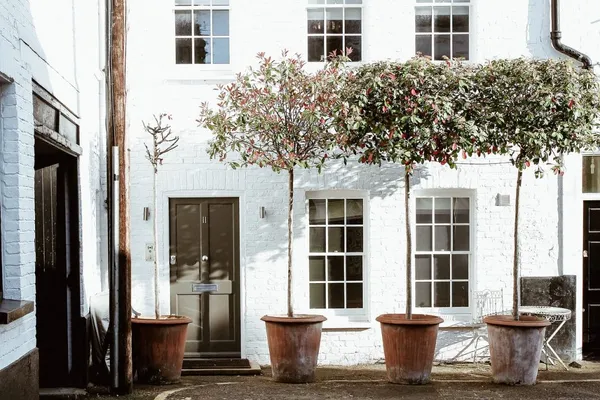
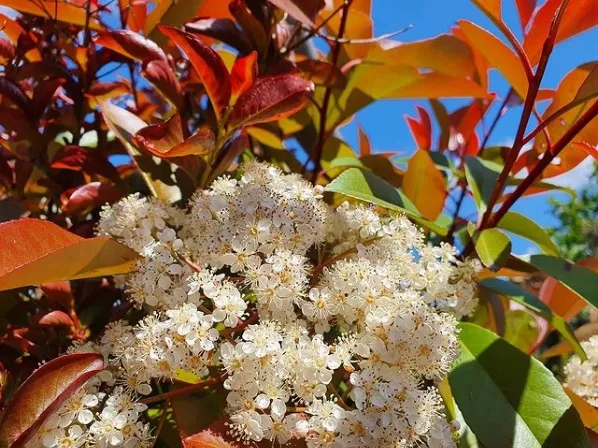
Photinia is a beautiful plant with lovely red foliage when it first sprouts. In the spring, it produces white clusters of small flowers. Photinia is also evergreen. It’s an easy plant that requires little maintenance. So Photinia is beautiful all year round! However, sometimes a Photinia may not grow as densely as you’d like, or it may become sparse or transparent in some areas.
Why does Photinia become sparse or lose its leaves, and how can you prevent this?
In this Garden Q&A blog, we explain when this can happen, why it happens, and how you can prevent it.
When does Photinia lose its leaves or become less full?
It is common for Photinia to lose its leaves or become less dense in the spring after flowering, but this can also occur during or immediately after winter.
Why is my Photinia losing its fullness?
After winter (and during wet winters), Photinia often drops its leaves. This is especially true if the location isn’t ideal—for example, if the plant is in a drafty spot. Photinia does not like cold winds. A damp location can also lead to problems. If the location is not optimal, Photinia is less resistant to frost. The risk of frost damage is then greater.
Many evergreen plants shed their old leaves after winter in order to produce fresh new ones. This is especially desirable with Photinia, because its new leaves, with their bright red color, are highly ornamental. New leaves often begin to appear as early as February or March.
What is the best location for Photinia, also known as Chinese snowball bush?
Photinia thrives in full sun or partial shade and prefers well-drained soil and good air circulation (to prevent fungal problems). A sheltered location out of the wind is recommended and helps prevent potential frost damage.
After flowering, there is also a high likelihood of gaps or bare spots appearing in the shrub. Photinia has a beautiful umbrella-shaped bloom, consisting of several flower panicles with small white flowers. In mature plants, the entire shrub can transform into a white umbrella of flowers!
The profuse flowering takes a lot of energy from the plant. There are usually fewer leaves where the flowers were. Once flowering is over, a sort of gap or opening may therefore appear in the shrub (or in the crown, if it’s tree-like).
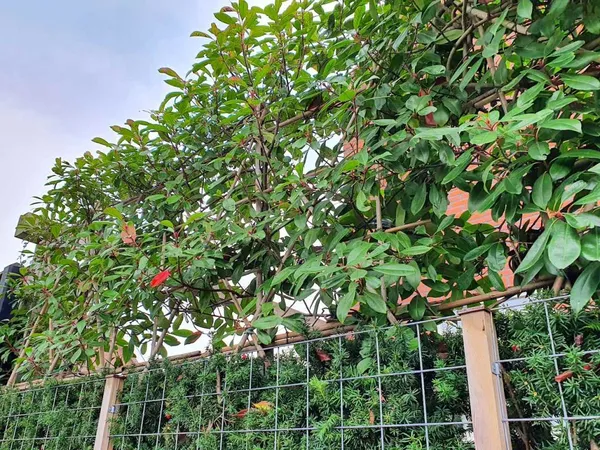
Why is my Photinia hedge turning transparent and bare?
Especially with espaliered trees, you can clearly see that the plant becomes less dense after winter or after flowering. This can result in large gaps in your espalier or on the trellis. As a result, you have significantly less privacy with an espaliered tree, which is obviously not ideal.
How can you prevent a topiary Photinia from becoming see-through or developing bare spots?
If the location is right, there’s really not much else you can do—at least as far as (temporary) leaf loss is concerned. Still, you can prevent your Photinia espalier from developing bare spots, especially if this is caused by flowering.
You could cut off the flowers early, so that new foliage forms quickly and as little energy as possible is wasted on flowering. It’s effective, but it’s a shame to waste those beautiful blooms…
Photinia is also well-suited for a slightly wider crown. If you let the espalier grow a bit wider (thicker), you’ll be much less likely to end up with a gap, opening, or bare spot. Think of a sort of cube shape on a trunk. If a gap does occur, there will still be enough foliage behind it, making it much less noticeable.
Ask your gardening question, too!
In our "Garden Questions" section, we answer all your questions about gardens, plants, and gardening.