
Which pine trees stay small and are suitable for a small garden?
Maybe you’ve been there: relaxing on vacation under a beach umbrella with a book. It’s the kind of atmosphere you might want to recreate at home. But would a pine tree actually be a good fit for your garden? And are there any pine trees that stay small enough for a small garden?
Absolutely! There are surprisingly many pine trees that remain compact—from small dwarf pines that barely reach a meter in height to distinctive small trees a few meters tall. This means there’s quite a selection even for a small garden.
In this article, small pine trees for the garden are divided into three groups: pines up to about 3 meters, up to about 5 meters, and up to about 8 meters. This makes it easy to see which pine is best suited to the available space.
Don't just consider the height. The width and growth habit also determine how much space a pine tree will eventually take up.
What is a dwarf den?
The smallest pines are often called dwarf pines. These are usually slow-growing, compact cultivars that remain much smaller than the original species. Examples include Pinus mugo "Pug" or Pinus strobus “Minima.”
But not every small pine is a dwarf pine. Some cultivars remain compact, but eventually grow into small trees several meters tall. It is precisely these differences that make it interesting to look beyond the name “dwarf pine.”
Overview of Small Pine Trees
| Den | Adult height | Width | Growth habit | Special |
|---|---|---|---|---|
| Pinus mugo “Pumilio” | 0.5–1 m | 2–3 m | Low and wide | Very compact in height |
| Pinus strobus “Minima” | 0.5–1 m | about 1 m | Compact, spherical | Long blue-green needles |
| Pinus mugo “Pug” | 1–2 m | 1–2 m | Round and compact | Ideal for small gardens |
| Pinus parviflora “Brevifolia” | 2–3 m | 1–2 m | Ascending/pyramidal | Blue-green needles |
| Pinus mugo mughus | approx. 2–4 m | approx. 2–4 m | Wide and irregular | Natural look |
| Pinus mugo “Gnom” | approx. 2–4 m | approx. 1–2 m | Ascending | Compact mountain hut |
| Pinus nigra “Nana” | approx. 2–4 m | approx. 2–3 m | Compact and wide | Tough look |
| Pinus parviflora “Negishi” | approx. 2–4 m | approx. 1–2 m | Ascending | Blue-gray needles |
| Pinus thunbergii “Thunderhead” | 3–5 m | 3–4 m | Wide and irregular | A tree with character |
| Pinus sylvestris “Watereri” | approx. 4–8 m | approx. 3–5 m | Wide, umbrella-shaped | Blue-green needles |
| Pinus parviflora “Glauca” | 5–8 m | 4–6 m | First, pyramidal | Striking gray-blue |
Don't just focus on the height
In a small garden, it's not just the height of a pine tree that matters. Its width and growth habit also determine how much space it will ultimately take up. For example, a low-growing pine can become quite wide.
For this article, we’ll use mature height as a practical classification so you can quickly see which pines stay small and which ones require a bit more space. The heights listed are approximate.
Pine trees up to about 3 meters
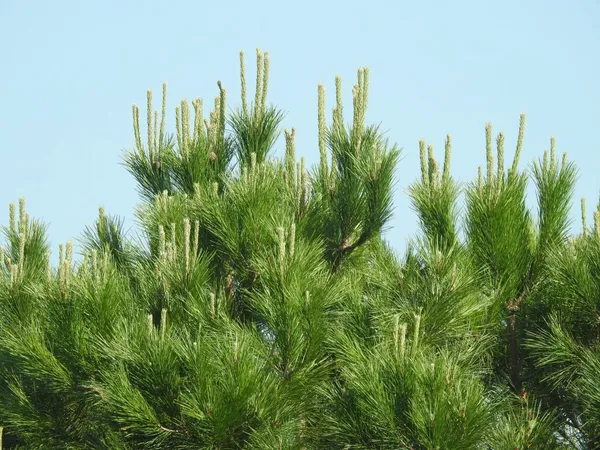
For a truly small garden, these are the most obvious choices among pine trees. They stay low, and some are also compact in width. Others, on the other hand, can grow quite wide, so it’s still important to consider their full mature size.
Some are true dwarf pines, while others grow into small, upright trees. You can clearly see that difference in the species listed below.
Pinus mugo “Pug”
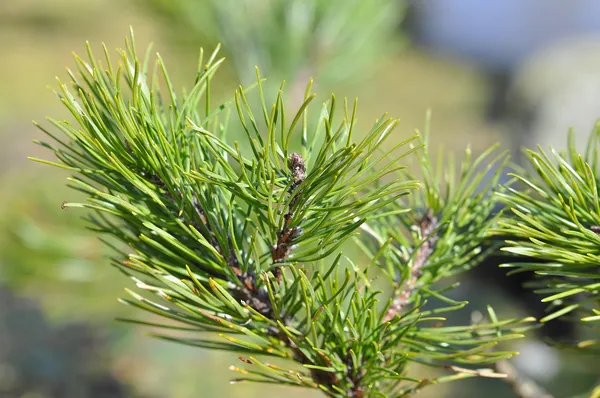
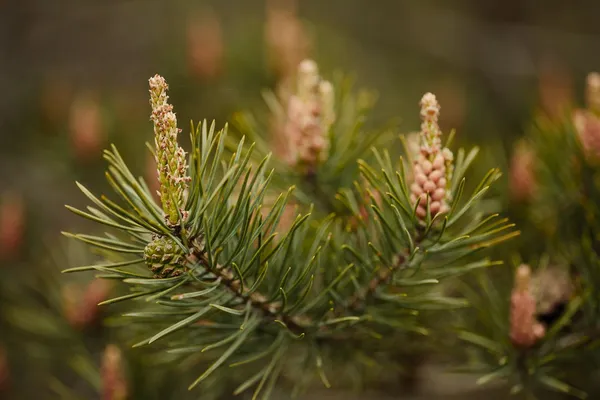
The mountain people ‘Pug" is a well-known compact pine that grows to about 1 to 2 meters in height and width. It grows densely and in a rounded shape and requires little pruning to maintain its compact form.
A good choice if you're looking for an easy-to-care-for, evergreen plant that will catch the eye.
Pinus parviflora “Brevifolia”
If you're looking for something special, check out Pinus parviflora ‘Brevifolia’ (Japanese white pine). This cultivar of the Japanese white pine grows to about 2 to 3 meters tall and 1 to 2 meters wide. Its blue-green needles and upright, pyramidal growth give it a refined appearance. It also looks beautiful as a multi-stemmed tree.
This makes this pine tree look much more like a real small tree.
Pinus strobus “Minima”
Pinus strobus ‘Minima’ (weymouthden) remains quite small, growing to about 0.5 to 1 meter. Its compact shape and blue-green, relatively long needles make it a good choice for a low border or a very small garden.
Other options
- Pinus mugo “Pumilio” (mountain range) — very low, but strikingly wide
Are you looking for more small trees? Then check out our article "Trees Up to 3 Meters"
A small pine tree doesn't have to look small
It is precisely within this first group that it becomes clear that height isn't everything. A pine tree less than a meter tall can take up quite a bit of space if it grows wide. As a result, a slightly taller, upright cultivar can sometimes be more practical in a small garden.
Pine trees up to about 5 meters
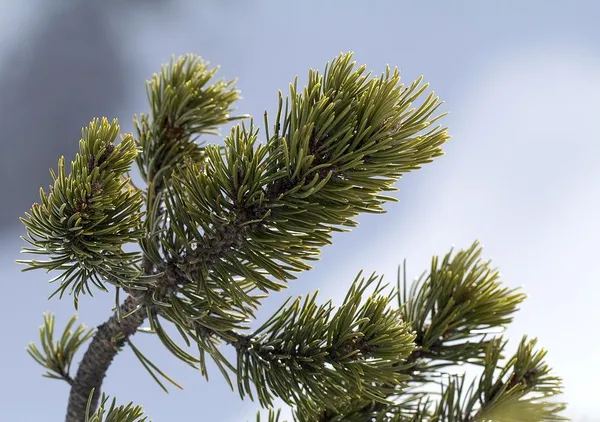
If you're looking for something a little taller, you'll find pine trees ranging from about 3 to 5 meters. This is an interesting category for those who aren't just looking for a compact conifer, but a pine that can truly serve as a small tree.
The growth habit is becoming increasingly important in this regard. A pine that grows wide requires more space than an upright cultivar of comparable height.
Pinus parviflora “Negishi”
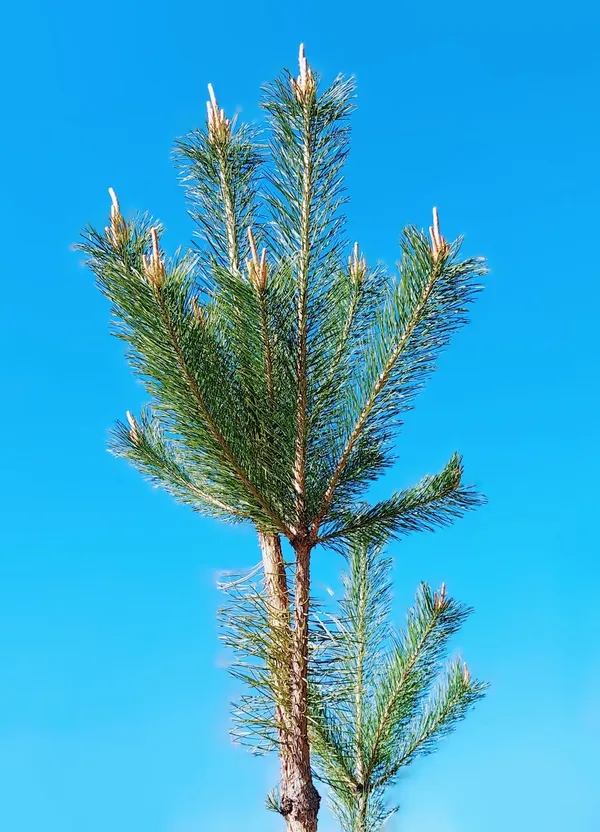
Pinus parviflora ‘Negishi’ (Japanese white pine) is an attractive pine for a small garden. The Japanese white pine grows slowly and upright and has striking blue-gray needles.
It combines a relatively modest size with the appearance of a true solitary tree.
Great for: a modern, Japanese, or tranquil garden where a single distinctive tree is desired.
Pinus thunbergii “Thunderhead”
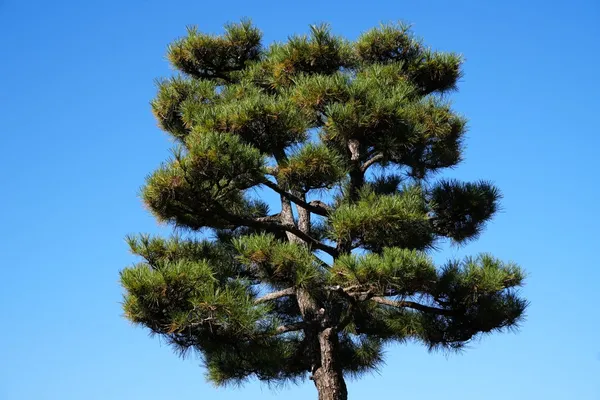
Pinus thunbergii ‘Thunderhead’ is a slightly more rugged choice. This cultivar of the Japanese black pine grows wide and in an irregular shape and can reach a height of about 3 to 5 meters.
As a result, it does take up more space than “Negishi,” but it also has a much stronger presence.
Great for: A natural or rustic garden with plenty of space around the tree.
Other options
- Pinus mugo mughus (dwarf den) — natural and irregular, approximately 2–4 meters
- Pinus mugo “Gnom” (dwarf tree) — compact and upright, about 2–4 meters
- Pinus nigra “Nana” (black pine) — sturdy and compact, about 2–4 meters
More height, without necessarily having a large tree
The pines in this category are a good choice if a garden could use some height, but a standard large pine would be too imposing. A slow-growing or upright cultivar, in particular, can strike a nice balance with the rest of the garden.
Pine trees up to about 8 meters
Up to 8 meters might not sound like a small tree anymore. Still, there are pine trees that reach this height and can still be a good fit for a small or slightly larger small garden.
In this category, the selection becomes more selective. The tree has a greater impact on the garden, and its eventual width becomes increasingly important. Therefore, the focus is primarily on pines that are deliberately chosen as small trees with character.
Pinus sylvestris “Watereri”
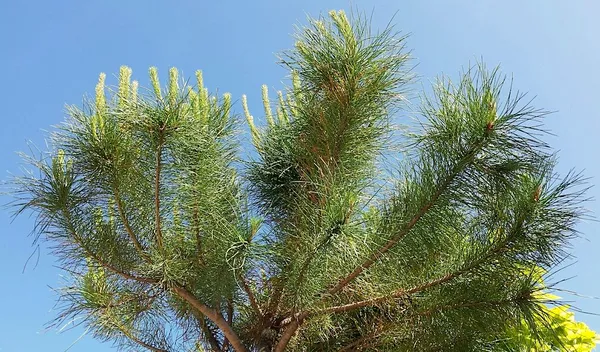
Pinus sylvestris ‘Watereri’ (Scots pine) is a compact cultivar of the Scots pine. It grows slowly and develops a broad, distinctive crown with blue-green needles.
It can eventually grow to a height of several meters, but its broad, often somewhat umbrella-shaped crown is just as distinctive. As a result, this cultivar possesses much of the character that many people find so appealing in a pine tree.
Great for: a secluded spot where the tree has room to develop its distinctive shape.
Pinus parviflora “Glauca”
Pinus parviflora ‘Glauca’, the blue Japanese pine, is notable for its gray-blue needles. It reaches a height of about 5 to 8 meters when mature, with a spread of approximately 4 to 6 meters. The crown is initially pyramidal.
That said, this is certainly not a tree for the tiniest of gardens. In a somewhat more spacious small garden, however, it can actually become a beautiful focal point.
Great for: Anyone looking for a truly small tree with striking blue-gray needles.
From a compact pine to a small tree
The three categories clearly illustrate just how much variation there is within Pinus ... A pine tree doesn't necessarily have to grow into a large tree.
For a very small garden, compact cultivars such as “Mops” and “Minima” are worth considering. If you’re looking for something a little taller, check out “Negishi” or “Thunderhead.” And where there’s more space available, ‘Watereri’ and ‘Glauca’ can grow into real showstoppers.
Which pine tree is right for your garden?
The best pine tree depends mainly on the available space and the look you want to achieve in your garden.
You don't have much space
Take a look at Pinus mugo "Pug" or Pinus strobus “Minima.” Be sure to pay close attention to the width when planting dwarf pines.
You want a small tree as a focal point
Pinus parviflora "Brevifolia" and "Negishi" are interesting choices in that regard. They remain relatively compact, but clearly have the appearance of a tree.
You like a natural, irregular shape
Take a look at Pinus mugo mughus or Pinus thunbergii “Thunderhead.”
You want a little more height and character
Then there are Pinus sylvestris “Watereri” and Pinus parviflora "Glauca" is an interesting choice, provided there is enough space for their eventual size.
You're looking for blue-gray needles
In that case, the main ones are Pinus parviflora “Negishi,” “Brevifolia,” and “Glauca” are interesting choices.
Can you keep a big pine tree small?
After seeing this list, a logical question might arise: Can't you just plant a larger pine tree and keep it small by pruning it?
Unfortunately, it’s not that simple with pines. You can prune a pine, but that won’t suddenly turn a large tree into a small one. Old wood without needles, in particular, usually doesn’t sprout again on pines. Cutting a large branch back far enough into the bare wood can therefore prevent new shoots from forming there.
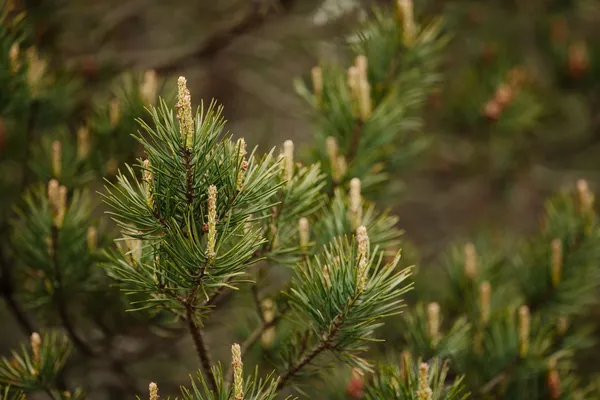
On some pine trees, the young shoots—known as “candles”—can be pruned back in the spring. This helps control growth to some extent and keeps the crown more compact. This is different from trying to prune a large tree down to a smaller size over the course of many years.
For a small garden, therefore, the most important thing is to choose a pine tree from the start that naturally fits the available space.
A pine tree like the ones you see on vacation might not be suitable for every Dutch garden. But that doesn’t mean a pine can’t find a place in a small garden. From a compact “Mops” in a flower bed to a distinctive “Watereri” as a small tree: there’s much more choice than you might expect.
Don't base your choice solely on height; instead, consider the combination of size, growth habit, and appearance. That way, even in a small garden, a pine tree can grow into a striking, evergreen focal point.