
Which groundcover plants have white flowers?
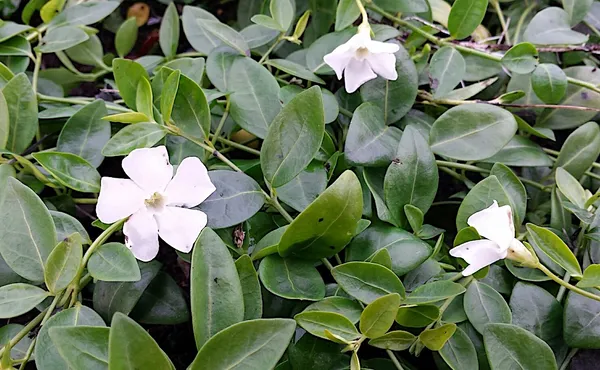
Of all ground covers, the white-flowering varieties are by far the most popular—especially the evergreen ones.
Are you also looking for a white groundcover that stays green in the winter?
There are quite a few white-flowering plants that are suitable as ground covers. However, many of them are not evergreen. That’s why here’s an overview of evergreen white ground covers and semi-evergreen ground covers that bloom white.
The 10 Most Beautiful Evergreen White Groundcovers
These ground covers stay green even in winter and produce white flowers. This means they’re beautiful all year round and especially so when they’re in bloom. Most varieties don’t bloom for very long, but there’s often a chance they’ll bloom a second time.
Vinca minor ‘Alba’ / ‘Gertrude Jeckyll’
Periwinkle (Vinca minor) is an excellent groundcover plant that is suitable for many different locations and conditions. The cultivars ‘Alba’ and ‘Gertrude Jeckyll’ bloom with many small white flowers in March and April. A second bloom may occur later in the year. Periwinkle forms a beautiful dark-green carpet of small, slightly glossy leaves.
Thymus praecox ‘Albiflorus’
Creeping thyme (Thymus praecox) is a groundcover that is well-suited to a sunny, dry location. The soil should not be too rich in nutrients. Creeping thyme has very small, light green leaves that have a wonderful fragrance. During its blooming period in June and July, this groundcover transforms into a sea of tiny white flowers.
Armeria maritima ‘Alba’
Sea thrift (Armeria maritima) is a groundcover that immediately brings to mind graceful tufts of grass. From May through July, sea thrift blooms with many small white flower heads.
Erica carnea or darlyensis
Doph heather, or winter heather (Erica carnea and Erica darlyensis), is an evergreen heather species that blooms for a very long time. From December/January through April, cultivars such as ‘White Perfection,’ ‘Isabell,’ and ‘Snow Queen’ bloom with beautiful white flowers. It prefers slightly acidic soil.
Sedum album
White stonecrop (Sedum album) is a good groundcover for sunny and dry locations. Its round leaves are light green and turn pink, red, or brown in the fall. This Sedum blooms in June and July with small, star-shaped white flowers.
Liriope muscari ‘Monroe White’
Lilyturf (Liriope muscari) is a plant with grass-like, dark green leaves. Its blooms in August and September are reminiscent of grape hyacinths in the spring. Lilyturf prefers a location in the shade or partial shade.
Iberis sempervirens
Wintercress (Iberis sempervirens) is a somewhat lesser-known evergreen plant that produces small flowers in April and May. The cultivars ‘Snowflake,’ ‘Zwergschneeflocke,’ and ‘Masterpiece’ produce beautiful white flowers. The latter also remains somewhat shorter and more compact. The green foliage of the ever-green candytuft is lance-shaped. This plant is also well-suited for coastal areas.
Ajuga reptans ‘Alba’
Bugleweed (Ajuga reptans) is an excellent groundcover that quickly forms dense mats. The leaves are oval, slightly glossy, and dark green. This Ajuga blooms with small white flowers in May and June. It can be used in a variety of locations.
Sagina subulata
Sagina (Sagina subulata) is a low-growing groundcover that forms dense mats. From a distance, it resembles a thick layer of moss. From May through August, stonecrop blooms with small white flowers. Sagina is sometimes used as a grass substitute, but it is less suitable for regular foot traffic.
Pachysandra terminalis
Pachysandra (Pachysandra terminalis) is ideal for shaded or partially shaded areas. It will thrive even in deep shade, such as under trees and large shrubs. It blooms from March through May with small (not very showy) white flowers. The foliage is dark green and, depending on the cultivar (“Green Sheen”), has a slight sheen.
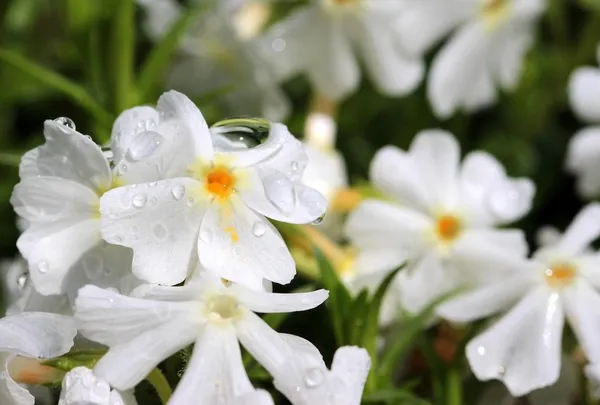
Semi-Evergreen White Groundcover Plants
Under the right conditions, these plants stay green even in winter. A sheltered location and good drainage are usually important. Some plants also retain their leaves for a very long time, provided the winters aren't too cold (or wet).
- Arabis caucasica (rice porridge or fringed flower)
- Campanula carpatica ‘Weisse Clips’ (bellflower)
- Campanula porscharskyana ‘EH Frost’ (bellflower)
- Cerastium tomentosum (woolly chickweed)
- Cotoneaster dammeri (dwarf cotoneaster)
- Geranium cantabrigiense ‘Biokovo’ / ‘St. Ola’ (crane’s-bill)
- Geranium macrorrhizum ‘Spessart’ (crane’s-bill)
- Galium odoratum (sweet woodruff)
- Gypsophila repens ‘Alba’ (baby’s breath)
- Lamium maculatum ‘Album’ / ‘White Nancy’ (deaf nettle)
- Lithodora diffusa ‘Alba’ (pearl or stone seed)
- Phlox subulata ‘Maischnee’ / ‘White Delight’ / ‘Calvides White’ (creeping phlox)