
Which climbing plants stay green in the winter?
There are an incredible number of climbing plants.
Fast-growing plants, slow-growing plants, climbing plants for a sunny spot, or for a shady spot instead…
But which climbing plants stay green in the winter?
Although they are in the minority, there are certainly evergreen climbing plants. Some may need a little protection in the winter or prefer a sheltered location. Others survive cold and wet winters without any trouble.
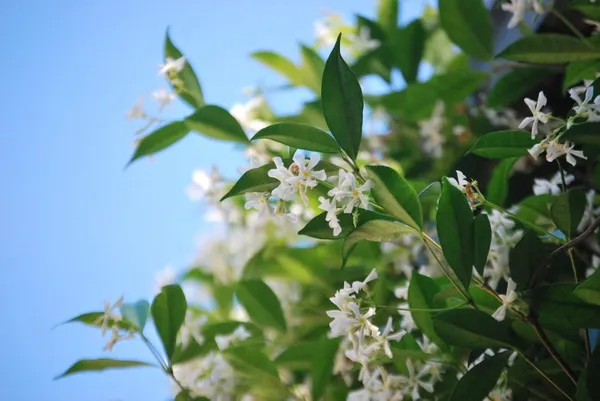
Trachelospermum jasminoides (Tuscan jasmine)
A beautiful evergreen climber with abundant blooms. It blooms from May through September with small white flowers that also have a delightful fragrance. Please note, however, that this jasmine is not fully hardy. In cold weather, the leaves often turn red. A sunny yet sheltered location is preferred.
Passiflora caerulea (blue passionflower)
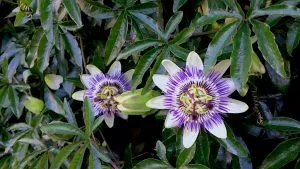
The passionflower has a distinctive leaf shape and exotic-looking blooms. Once this plant blooms, it creates a spectacular sight in the garden! In addition, the leaves remain on the plant for a very long time in winter and often don’t fall off at all. It blooms from July through September, producing very distinctive blue-and-white flowers. After a warm summer, tropical-looking, edible orange fruits develop.
Young plants, in particular, have moderate cold hardiness. In the first few years, it’s best to provide some protection during the winter. Once it’s well-established and a bit larger, the passionflower can tolerate moderate frost just fine. Still, a sheltered location is recommended. The passionflower also thrives in full sun. In addition to the blue passionflower, the white-flowering Constance Elliot variety is also fairly hardy (down to -12℃).
Pyracantha (firethorn)
Strictly speaking, firethorn isn’t a true climbing plant, but a shrub. Still, it works very well as a climbing plant. There are several varieties available with brightly colored berries, ranging from red to orange and yellow. Pyracantha retains its leaves through most winters, and the numerous berries often remain on the plant throughout the winter. More berries will form in a sunny spot.
Lonicera henryi (honeysuckle)
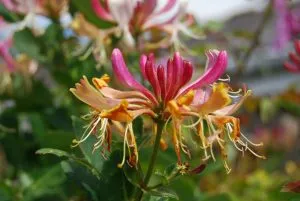
An evergreen honeysuckle with purple-red and cream-yellow flowers. It blooms less profusely than many other honeysuckles, and leaf drop may still occur during harsher winters. This variety has a light fragrance. It can be planted in both sunny locations and partial shade. Some shelter helps prevent leaf drop.
The 'Copper Beauty' cultivar is popular. It has yellow-pink flowers, and its young leaves are copper-colored. It loses fewer leaves than the common henryi. In addition, the leaves turn a purplish-red color in the fall.
Clematis armandii (evergreen wood clematis)
Perhaps the best-known evergreen clematis, with long, leathery leaves. In mild winters, the armandii stays a beautiful green. This wood-climbing clematis blooms in March and April with many white, star-shaped flowers. The cultivar Apple Blossom produces soft pink flowers. The Snowdrift cultivar, like the standard armandii, has white flowers but blooms more profusely.
Clematis 'Early Sensation' (woodland climber)
In addition to the well-known armandii, there are several other evergreen clematis varieties. One of these is the Clematis Early Sensation. This clematis blooms with white flowers in March and April. After its (early) bloom, so-called seed heads form, creating a striking display. Please note, however, that this clematis is not fully hardy and can tolerate temperatures down to about -5℃. A sheltered location is therefore highly recommended.
Clematis Joe (woodland clematis)
The Clematis Joe also stays green in the winter. This wood-climbing clematis has many white flowers with a yellow pistil and blooms in April and May. Its serrated leaves are also distinctive. It is hardy down to about -12℃. The early-blooming Clematis Joe remains relatively short, growing to about 1 meter.
Clematis Pixie (woodland climber)
Clematis 'Pixie' is also an evergreen climbing clematis that blooms with creamy white and green flowers that have a light fragrance. Pixie is also an early-blooming clematis, flowering in March–April. This wood-climbing variety is hardy down to about -12℃. It is a compact grower and can also be used as a groundcover.
Clematis Avalanche (woodland clematis)
Another early-blooming, evergreen clematis is Clematis Avalanche. It blooms from March through April, and this vine produces an abundance of white flowers. It’s a fairly fast-growing plant.
Hedera (ivy)
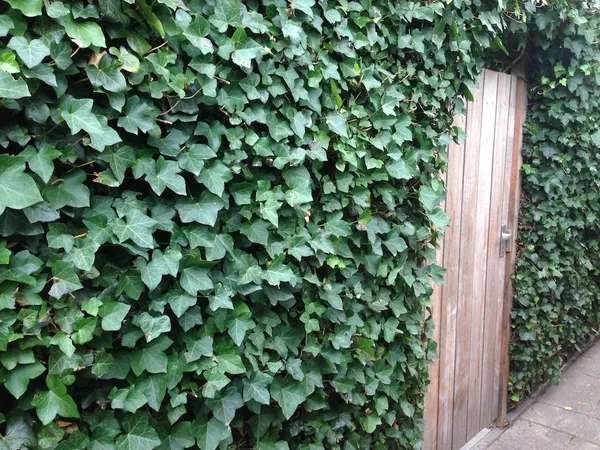
Ivy is perhaps the easiest (climbing) plant there is. In other words, this plant takes root almost anywhere. So well, in fact, that you have to keep pruning it, because otherwise it will almost certainly run rampant. Still, this plant is ideal for dense, evergreen hedges or for concealing less attractive features in the garden. The best-known varieties are Hedera helix (small-leaved ivy) and Hedera hibernica (large-leaved ivy). Both varieties are highly hardy. Be careful, though, because Hedera is self-clinging. The clinging roots can leave marks on stone and wood.
In the fall, ivy is a valuable plant for insects because it continues to provide them with food. Incidentally, flowering and fruit formation occur only in mature plants and hedges that are not pruned too heavily.
Which evergreen climbing plant will you choose?
So there are still quite a few options if you want an evergreen climbing plant in your garden.
Which one is your favorite?