
What to plant on a sloping hillside (embankment)?
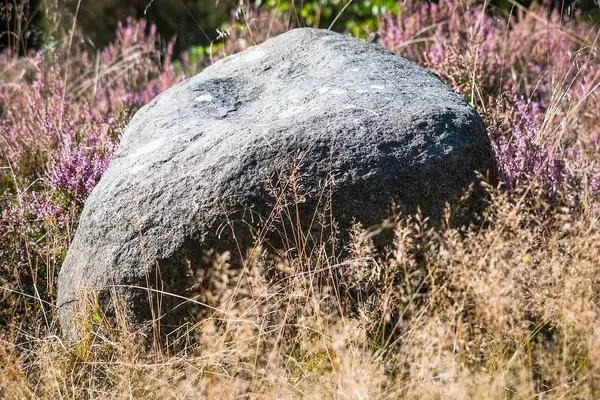
A sloping hillside (also known as an embankment) is not a good place for many plants to grow.
The risk of drying out is very high, and it is usually difficult to achieve nice, even growth across the sloped surface.
Planting and caring for plants on a slope is often difficult as well, because access is limited and digging a planting hole on a sloped or incline surface can be quite a challenge… Especially on a steep slope!
Fortunately, none of this is a reason to leave sloped areas bare or even to simply pave them. There are certainly plants that can grow on a slope. This way, you can also make the most of sloped areas in your garden. The roots of the plants also help prevent erosion.
Groundcover Plants for a Sloping Hill or Embankment
A popular choice for sloping areas or embankments is to use groundcover plants. These low-growing plants (often evergreen) take root firmly and often form a nice, dense mat. Be sure to check out our A complete list of good groundcover plants, for more tips.
- Ajuga reptans (creeping bugle, susceptible to drying out)
- Calluna vulgaris (common heather)
- Cotoneaster dammeri (dwarf cotoneaster)
- Erica carnea (winter heath)
- Geranium (often prone to drying out)
- Hedera helix (small-leaved ivy)
- Hedera hibernica (large-leaved ivy)
- Lavandula angustifolia (lavender)
- Rosa The Fairy (groundcover rose)
- Sedum (stonecrop)
- Vinca minor (periwinkle)
- Waldsteinia ternata (Gouda strawberry)
Shrubs and Trees for a Slope or Embankment
When dealing with a larger sloped area, it might be a good idea to use taller plants as well. The following shrubs and trees are suitable for a sloped area. But keep in mind that they naturally grow quite large on their own—let alone on a slope!
- Amelanchier lamarckii (sour cherry tree)
- Betula (birch; grows very large)
- Buddleja davidii (butterfly bush)
- Hippophae rhamnoides (sea buckthorn)
- Hypericum calycinum (deer grass)
- Ilex aquifolium (holly)
- Juniperus (juniper)
- Pinus (pine; grows very large)
- Rhododendron (grows large)
- Rhus typhina (sumac, invasive)
- Rosa canina (dog rose)
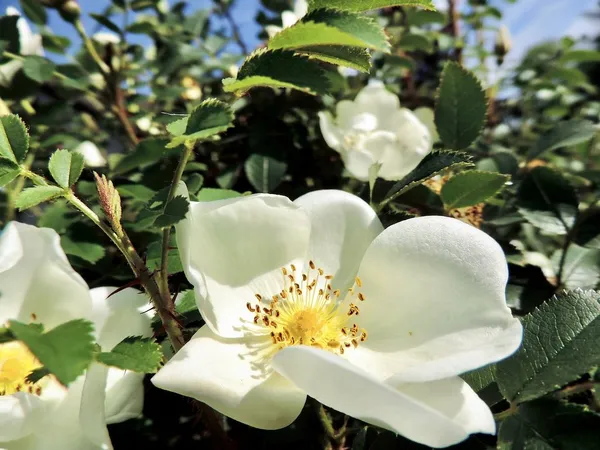
- Rosa pimpinellifolia (dune rose)
- Rosa rugosa (wrinkled rose)
- Viburnum davidii
Slope with Ornamental Grasses
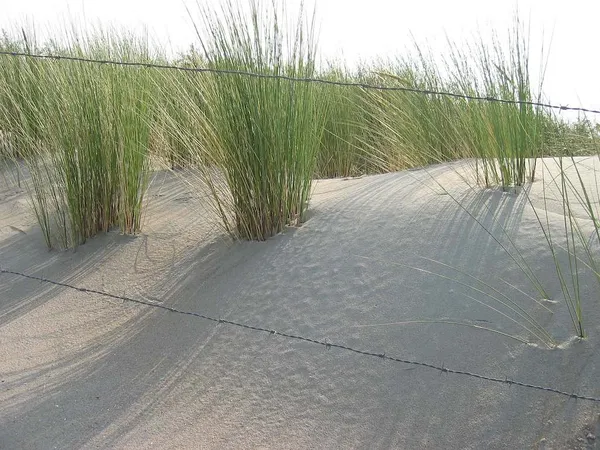
Think of a grassy slope, and you think of the sea… Helmet grass, or dune grass, is therefore certainly well-suited for sunny slopes with poor, dry soil. But many ornamental grasses thrive in similar conditions. This means they can also be planted on a sloping hillside quite easily. Still, not all ornamental grasses seem to thrive on a slope. The ornamental grasses listed below are suitable for slopes:
- Ammophilla arenaria (sand reed)
- Carex (sedge)
- Festuca gautieri (fescue)
- Festuca glauca (blue fescue)
- Leymus arenarius (sand oatgrass, invasive)
- Schizachyrium scoparium (small prairie grass)
- Stipa calamagrostis (diamond grass)
- Stipa tenuissima (feather grass)
Climbing Plants for a Sloped Hill
Many climbing plants are also suitable for slopes. If the slope isn’t too steep, they’ll grow as a kind of groundcover. You can let the plants grow from the top and hang down, or let them grow upward from the bottom. At the bottom of a hill or slope, they’ll have an easier time getting enough water to grow well. The following climbing plants are suitable for planting on a slope:
- Clematis (woodland clematis)
- Hedera (ivy)
- Lonicera (honeysuckle)
- Parthenocissus (wild grapevine)
- Trachelospermum jasminoides (Tuscan jasmine or star jasmine)