
These plants are essential for a Japanese garden
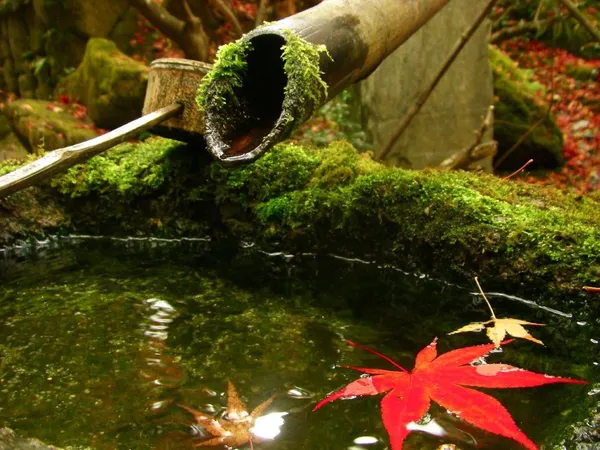
Japanese gardens are truly special!
They exude calm and tranquility and remain a beautiful green even in winter.
Not only are they beautiful green gardens with a calm and soothing atmosphere, but they also make extensive use of symbolism. Every element—the materials and all the plants—is carefully chosen and often has a special meaning. The art of a good Japanese garden lies in knowing when to hold back.
The use of only a few (natural) materials and the choice of primarily evergreen shrubs are characteristic of the Japanese garden style. In Japanese gardens, special attention is often paid to each individual plant. For example, they are pruned to perfection, or their natural and whimsical shapes are emphasized.
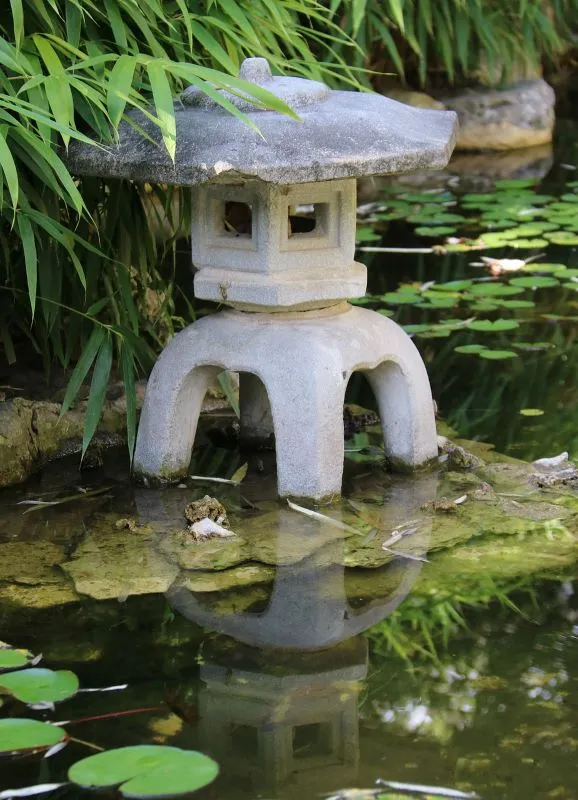
Water is an essential element in a Japanese garden. Ideally, this should be an actual water feature, but in a small garden, you can of course incorporate it with a mini pond or a water ornament. Natural stone and boulders are also characteristic of this garden style. Decorative gravel or crushed stone is often used as well.
Creating a true Japanese garden is very difficult, especially when you take all the symbolism into account. Still, in Western countries, we often choose to focus primarily on incorporating an Eastern atmosphere into the garden when we think of a Japanese garden.
With the plants listed below, you can create a true Japanese garden—or at least a beautiful garden with an Eastern feel.
Plants for a Japanese garden or an Oriental-style garden
Trees for the Japanese Garden
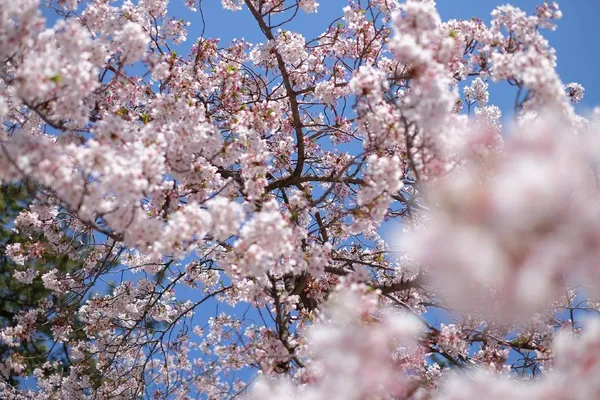
Prunus serrulata (ornamental cherry)
Ornamental cherry trees are a hallmark of the Japanese garden. Their graceful blossoms herald the arrival of spring and create a beautiful sight in the garden, even if it often lasts only a short time. If you have room for a tree in your garden, choose your favorite ornamental cherry. An added bonus is that many ornamental cherry trees also display beautiful fall colors. This way, you can enjoy your tree throughout multiple seasons—which is especially important in a small garden.
>> See also: Which ornamental cherry trees stay smaller?
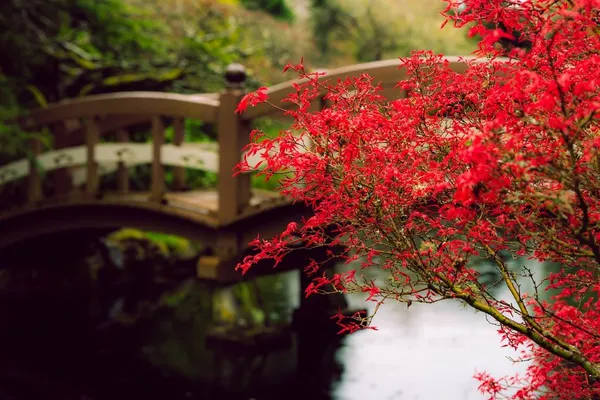
Acer palmatum) Japanese maple
A Japanese maple is a small tree, sapling, or miniature tree that is also a must-have in any Japanese garden. There are many cultivars. They are known for their beautiful, hand-shaped leaves and spectacular fall colors. They are elegant little trees—graceful in form and often quite open (even when in full leaf), so they won’t immediately block your view. Many varieties do not grow much taller than 2 meters, but there are also varieties that reach 3–4 meters in height. They look truly stunning next to a pond or water feature in the garden. There are also Acer species with red leaves and varieties that change color several times a year. Japanese maples prefer a spot in partial shade and, ideally, one that’s somewhat sheltered from cold winds.
Magnolia (false tulip tree)
If you have room for a second tree (or a larger shrub), a magnolia (false tulip tree) is a wonderful choice for your Japanese garden. The large flowers that bloom on the still-bare branches are very striking and transform the appearance of this unique tree (or shrub). The growth of these beautiful plants often looks very natural. Pruning isn’t really recommended (unless your specimen gets too big). Most cultivars develop lovely, large foliage, and some even produce a (light) second bloom in the summer.
Garden Question: Which magnolias stay smaller and are suitable for a small garden?
Pinus (pine)
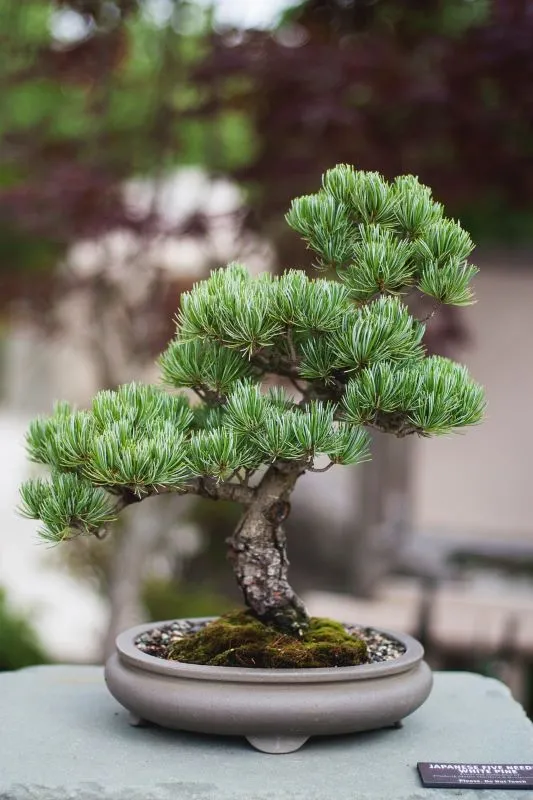
A true Japanese garden should also include a pine tree. Of course, most pine species grow much too large for a small garden. Still, there are options even for this. Some species (e.g., Pinus pinea) are now available as grafted plants, which keeps them much smaller. You could also consider a shrub-like variety (Pinus parviflora) or a dwarf variety (e.g., Pinus mugo mughus). Using a pine for bonsai also creates a very special effect!
Shrubs for the Japanese Garden
Cornus kousa (large-flowered dogwood)
The large-flowered Japanese dogwood is an ideal shrub (or small tree) for a small garden. There’s something to see in every season! It’s a stately plant with striking large white flowers (or pink, depending on the cultivar). Strictly speaking, these aren’t flowers, but bracts. Either way, in May and June, the whole plant is covered with them! In the summer, this dogwood produces red, lychee-like fruits. The beautifully shaped, slightly wavy leaves turn stunning shades of yellow, orange, and red in the fall.
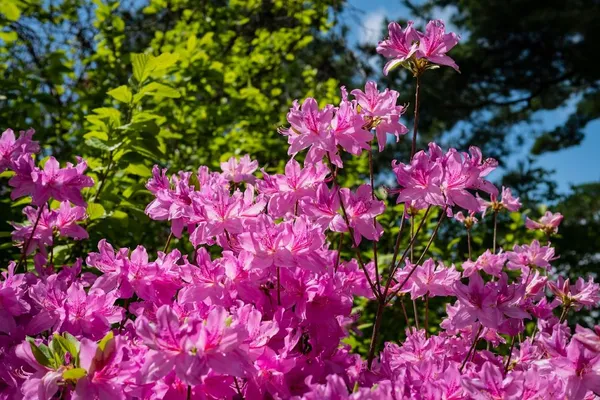
Rhododendron and Azalea
Azaleas and rhododendrons are a great addition to a Japanese garden. In the spring, they produce a sea of flowers. Although these plants may seem a bit plain after they finish blooming, they provide the distinctive green look of a Japanese or Oriental garden for the rest of the year, with their (large) dark, glossy leaves.
Not only do they usually have beautiful (large), glossy leaves and stay (dark) green in the winter, but their spring blooms will transform your entire garden!
Enkianthus campanulatus (bellflower)
The bellflower is a plant you don’t see very often in many gardens anymore, but it’s certainly a common sight in Japanese gardens. It’s a graceful shrub that produces hanging clusters full of white-pink bell-shaped flowers in May. In late summer, green seed pods form on long stems. Enkianthus also develops a very beautiful red fall color.
Topiary in the Japanese Garden
The Japanese garden is, of course, also very well known for topiary and the art of bonsai. Evergreen hedge plants with small leaves are particularly well-suited for this purpose. A large portion of gardens with an Eastern style or atmosphere consists of evergreen (hedge) plants. These are pruned into all kinds of shapes, ranging from neat blocks to cloud-like formations. Plants that are particularly well-suited for this include Ilex crenata, Taxus baccata, Lonicera nitida, and Buxus sempervirens (or, nowadays, boxwood substitutes). With these types of plants, you can prune the most beautiful shapes, down to the millimeter!

Bamboo in the Japanese Garden
Invasive Bamboo (Phyllostachys)
For us, bamboo is inextricably linked to Japanese (and Chinese) gardens. Phyllostachys is one of the best-known species. As long as you take precautions to prevent overgrowth and unwanted spread, it’s a beautiful and iconic plant. Once established, they can grow tall very quickly. Yellow and black stems seem to be particularly popular.
Non-invasive bamboo (Fargesia)
Fortunately, there is also an alternative to the invasive bamboo species: Fargesia. This is a clumping bamboo, which means it does not produce unwanted underground runners. Still, Fargesia has a similar appearance. Most varieties grow somewhat more slowly (compared to Phyllostachys, for example) and become slightly more translucent in the winter. Still, they are beautiful plants that instantly create an oriental atmosphere.
Moss and Moss Substitutes in the Japanese Garden
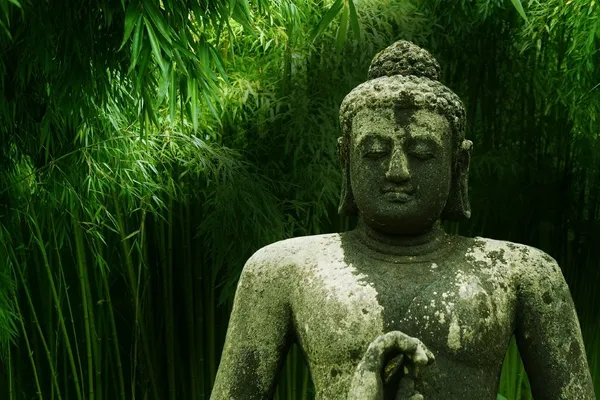
One of the most striking aspects of a traditional Japanese or Asian garden is that many surfaces are completely covered with moss. Although moss growth in a small garden (with plenty of shade) is often not a problem, it can take years for a surface to become covered, and it’s almost never possible to get it to grow exactly where you want it…
To achieve a similar effect, you might consider moss substitutes. These are attractive ground covers in their own right that are well-suited to an Oriental garden style:
- Pachysandra terminalis
- Leptinella squalida
- Sagina subulata
Climbing Plants for the Japanese Garden
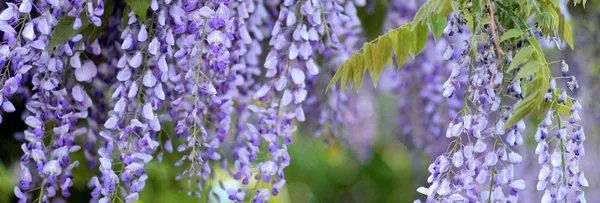
Wisteria (blue wisteria)
Wisteria is one of the most beautiful climbing plants. Not only is its profuse flowering a feast for the eyes, but its often delightful fragrance is also well worth experiencing. The foliage is graceful, and these plants are vigorous growers that also develop a beautiful (twisted) trunk. In Japanese gardens, you’ll find countless cultivars: wisteria with the longest flower clusters, extra-large flowers, wisteria that blooms repeatedly, and even white (blue) wisteria and pink (blue) wisteria.
Lonicera japonica (Japanese honeysuckle)
Honeysuckle is another climbing plant used in Japan. These are usually varieties that have a more natural appearance. However, there are now also several well-known cultivated varieties of Lonicera japonica, such as Hallianan and Hall’s Prolific.
Perennials and ornamental grasses for the Japanese garden
- Acorus (calamus)
- Anemone hybrida (autumn anemone)
- Athyrium (lady fern)
- Carex (sedge)
- Dryopteris (kidney fern)
- Equisetum (horsetail)
- Hakonechloa macra (Japanese ornamental grass)
- Helleborus (Christmas rose)
- Heuchera (coral bells)
- Hosta (plantain lily)
- Imperata cylindrica (blood grass)
- Iris ensata (Japanese iris)
- Nymphaea (water lily)
- Ophiopogon (black grass)
- Paeonia suffriticosa (tree peony)
- Polystichum (needle fern)
Even More Plants for the Japanese or Oriental Garden
In addition to the plants described above, you might also consider Camellia japonica, Chaenomeles japonica, Cornus officinalis, Cydonia oblonga, Ginkgo biloba, Hydrangea serrata, Nandina domestica, Pieris japonica, Skimmia japonica, Viburnum plicatum…