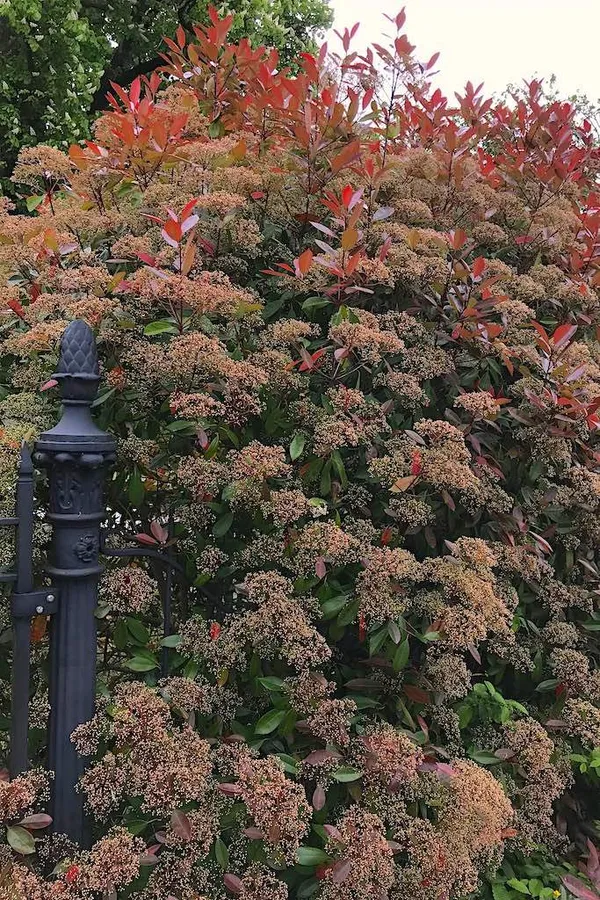
The Most Beautiful Evergreen Trees for Small Gardens
We previously wrote a blog post about the most beautiful deciduous trees for small gardens. But of course, there are also evergreen trees that are worth considering. They’re ideal, for example, for providing year-round privacy or adding a beautiful evergreen structure to your garden.
To be suitable for a small garden or an urban garden, it’s important that the trees don’t grow too large—or at least don’t grow very quickly. Here are our favorite compact evergreen trees.
5 Most Beautiful Evergreen Trees for Small Gardens
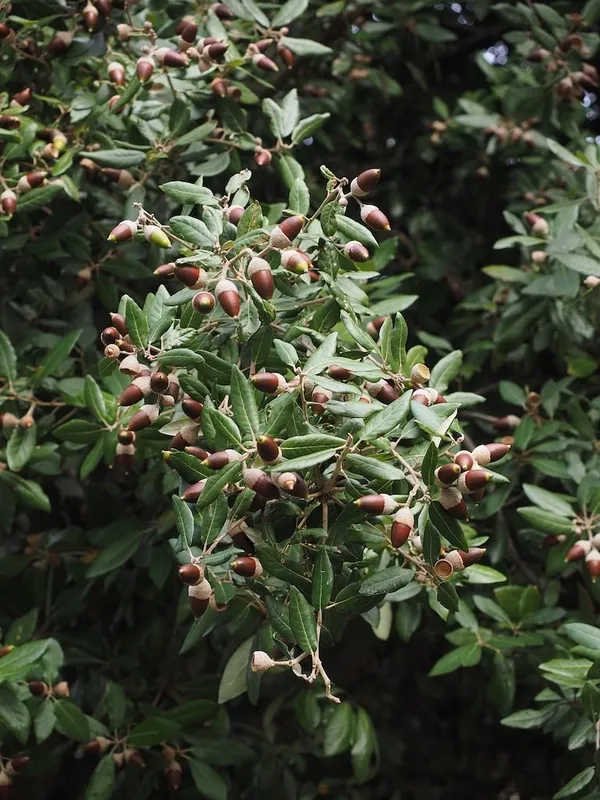
Quercus ilex (holm oak)
The holm oak is a beautiful tree with gray-green, leathery leaves. Thanks to its distinctive leaf color, the Quercus ilex quickly adds a Mediterranean touch to your garden. The trunk is also gray in color. These trees grow with dense branches and a narrow, upright shape. Only when the tree is quite old does it begin to spread out.
In the Mediterranean region, holm oaks can grow to about 20 meters tall, but in our climate they remain much smaller (usually about 5–8 meters). The holm oak is fairly drought-tolerant and also withstands sea breezes well. In May, male trees produce yellow catkins, and in the fall, elongated acorns grow on the tree.
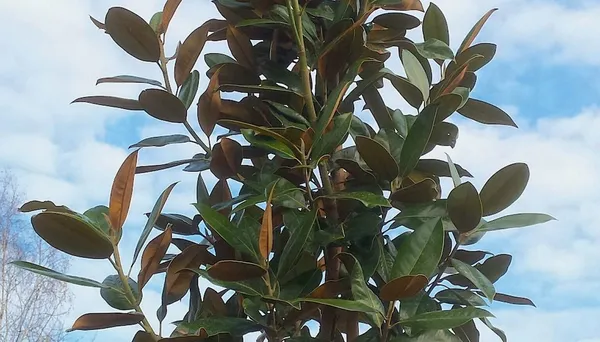
Magnolia grandiflora “Gallissoniere” (evergreen magnolia)
The evergreen magnolia (Magnolia grandiflora) is a beautiful tree with large, stiff leaves. The oval leaves are glossy dark green on top and brown on the underside. The lower leaves hang downward, but young leaves (at the top) point upward, so that the light brown undersides of the leaves are also visible among the green at the top. This contrast in leaf color gives the tree its distinctive appearance. New leaf buds resemble budding flowers, thanks to their soft, downy covering. The trunk is gray and the branches are brown.
In the summer, the plant produces impressive, enormous white flowers. Striking yellow stamens are visible in the center of the saucer-shaped flowers. You can smell the wonderfully sweet fragrance from a distance. The flowers close in the evening, as well as when there is heavy rain. Unfortunately, the flowers bloom only briefly, but the seed heads remain on the plant for some time. In very hot summers, fruit may form.
Not all cultivars are very hardy, but the Gallissoniere is. This tree usually grows to about 6 meters tall in our region.
Olea europaea (olive tree)
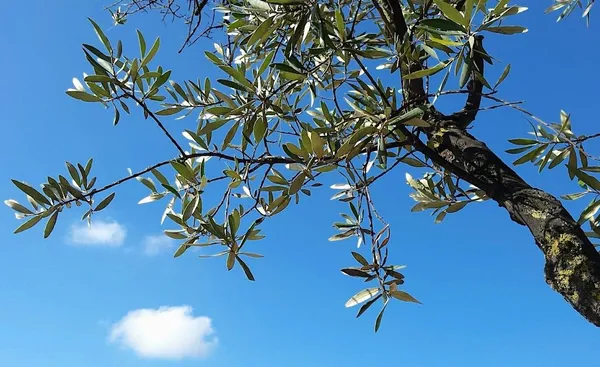
Olive trees are still very popular. And for good reason, of course, because an olive tree instantly adds that much-sought-after Mediterranean atmosphere to your garden, and these uniquely gnarled trees are truly a sight to behold. This is especially true of an older specimen, with a thick, gnarled gray trunk.
The many small leaves are greenish-gray, and olive trees grow with dense branches. In early summer, small yellowish-white flowers appear, which later develop into black olives. In our climate, the olives usually won’t fully develop, let alone ripen. Still, an olive tree laden with tiny olives creates a real vacation vibe right in your own backyard!
Olive trees are not fully hardy and could certainly use some protection from the cold, especially during their first few years. It helps to ensure adequate drainage, as they should definitely not be left standing in wet soil, especially in winter. Here, olive trees typically grow to only about 3–4 meters tall.
Trachycarpus fortunei (fan palm)
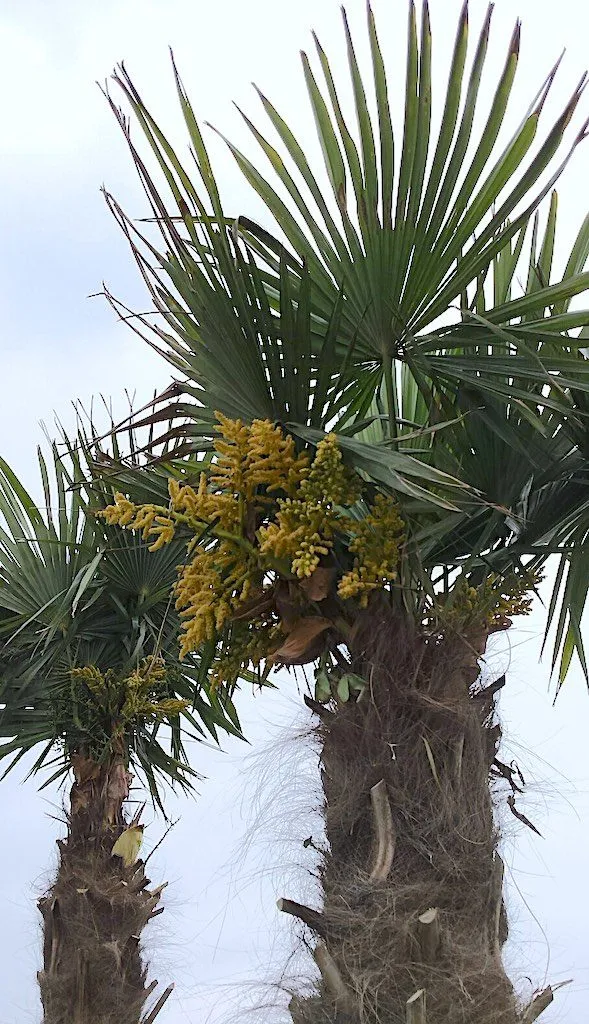
A palm tree is truly indispensable for a Mediterranean, tropical, or exotic garden. The Trachycarpus fortunei (Chinese fan palm) is particularly well-suited for this purpose, as it is one of the hardiest varieties. These palms grow with large, striking, upright, long, and narrow leaves. Often, part of the long leaf bends slightly, causing the tip to hang downward.
The sturdy, straight trunk is noticeably hairy. From April through June, the palm may begin to flower (if it is old enough), after which new seeds form and remain attached to the palm for quite some time.
It may take a few years for a newly planted fan palm to reach its full growth rate, but once it does, Trachycarpus can grow about 30–40 cm per year. Here, they usually do not grow taller than 2.5–5 meters.
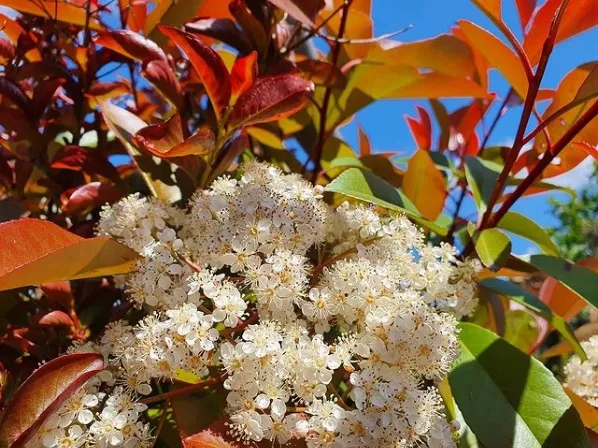
Photinia fraseri “Red Robin” (glossy photinia)
The photinia is a beautiful evergreen tree (which is also often sold as a hedge plant or shrub). Photinia has large, glossy dark green leaves. New shoots are red to brownish-red in color, giving this tree a beautiful red sheen in the spring. Around May and June, the photinia blooms profusely with white flower clusters. Black berries follow after flowering.
Photinias have a bushy growth habit, which can be further encouraged by pruning. However, this may come at the expense of flower production and berries. The photinia typically grows to a height of about 3–4 meters.