
Planting a Narrow Flower Bed (with a Sample Plan)
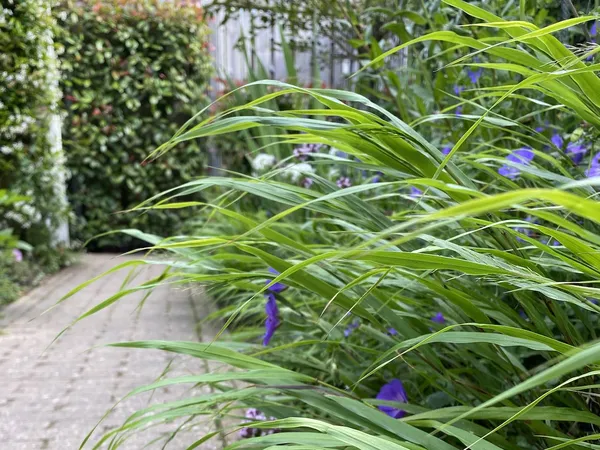
On the internet, you see the most beautiful plant combinations in large gardens or very wide plant borders. But you only have a narrow border yourself. In that case, you’ll need to take a completely different approach. With these tips, your narrow border will still be a huge success!
In this blog post, Lianne Groeneveld (Vergroenster) shares practical tips for greening up your small garden. This time, she features a beautiful example of a flower border.
Sun and Shade
You might be tempted to plant just one type of plant throughout the entire border. It looks serene, and it’s quick and easy. But… if you thought that was such a good idea, you wouldn’t be reading this. Planting just one type of plant is often boring.
Also: do some research. How does the sun hit that spot throughout the day? If you plant the same plant in a long, narrow border that has shade on one side and sun on the other, everything will grow all over the place.
Let go of that strict symmetry. Remember, you can always move a plant again in the fall or early spring. Have fun experimenting!
First, figure out what your taste is
Forget about limitations—for now, just think in terms of flower colors and foliage colors. Do you like white, pink, and purple? Try adding a warm hue, like a touch of orange or yellow, for a fun twist. Especially in a narrow border, it’s really fun to mix and match different leaf shapes and colors. A large, dark-green leaf looks stunning next to a small, light-green one.
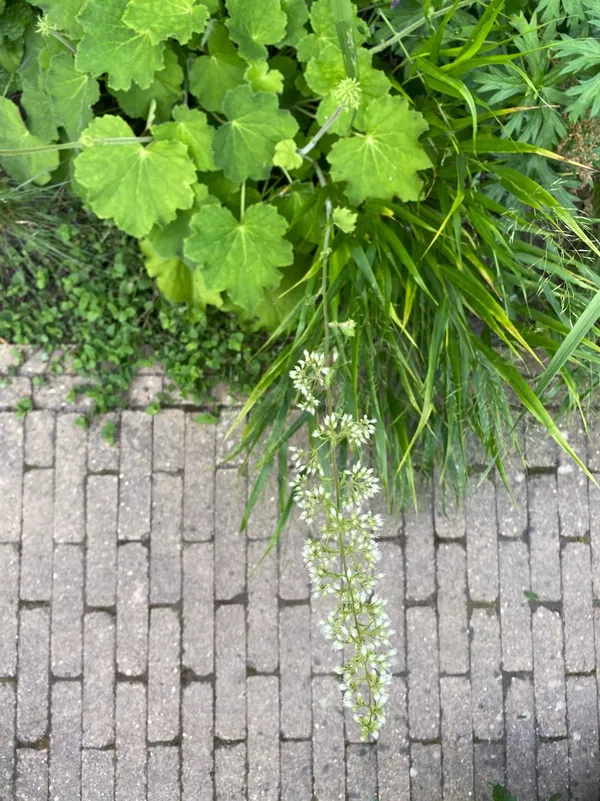
Heuchera, Hakonechloa
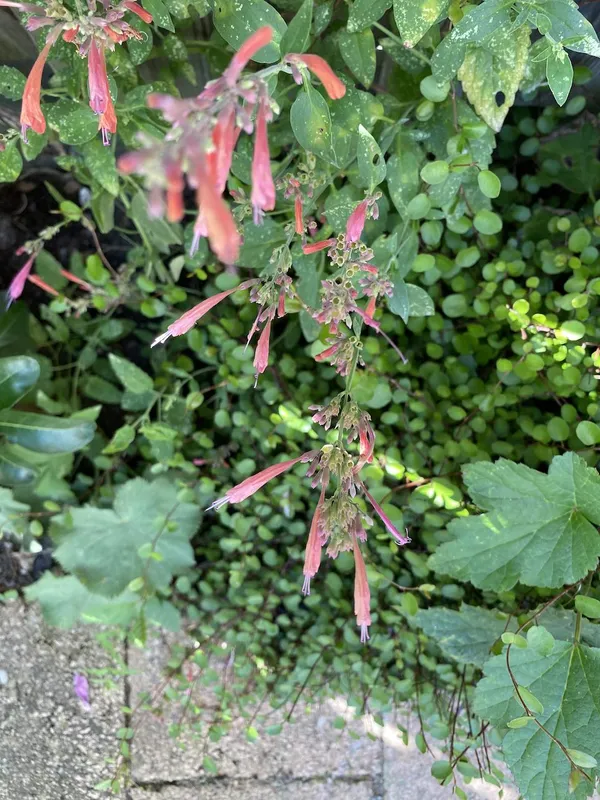
Agastache, Muehlenbeckia
Height
You may be limited in width, but can you go up in height? You often see narrow flower beds along a fence or wall. Why not start with a climbing plant? Wisteria is wonderful in a vertical garden, but is it suitable for your space? It requires a lot of pruning and grows extremely tall. In a sunny spot, a grapevine is ideal—and you can even eat the grapes. Could you perhaps make the flower bed a little wider by removing an extra tile?
Planting Plan for a Narrow Border
Suppose you have a border measuring 3 meters by 50 centimeters along a wall or fence. This will be the starting point for our planting plan.
Plant one or two of the same climbing plants, such as honeysuckle (Lonicera), in the center at the back. They can grow right into each other.
Suppose there’s more shade on the left side; in that case, use more shade-loving plants there, part-shade plants in the middle, and sun-loving plants on the right side. Symmetry won’t work, so don’t worry about it—just find balance in another way.
You can use one tiny shrub in the center, such as rosemary (Rosmarinus officinalis) or sage (Salvia officinalis). They’re wonderful in the kitchen. Shrubs like hydrangeas grow much too large. Choose the rest of the plants based on leaf shape and color.
Plant the same variety of ornamental grass twice, but offset from the center. Pay close attention to their shade requirements. Shade-tolerant grasses often stay shorter, so they’re ideal. Don’t plant them in direct sunlight.
For plants 1 and 2, you could choose a yellow-green leaf; for plants 2 and 5, something more gray-green, such as lavender (Lavandula) or Byzantine betony (Stachys byzantina). Plants 4 and 7 should have dark green foliage, such as bugle (Ajuga). Plant 6 can be just a little different.
Be careful with red foliage—it can quickly become too overwhelming. Vary the heights.
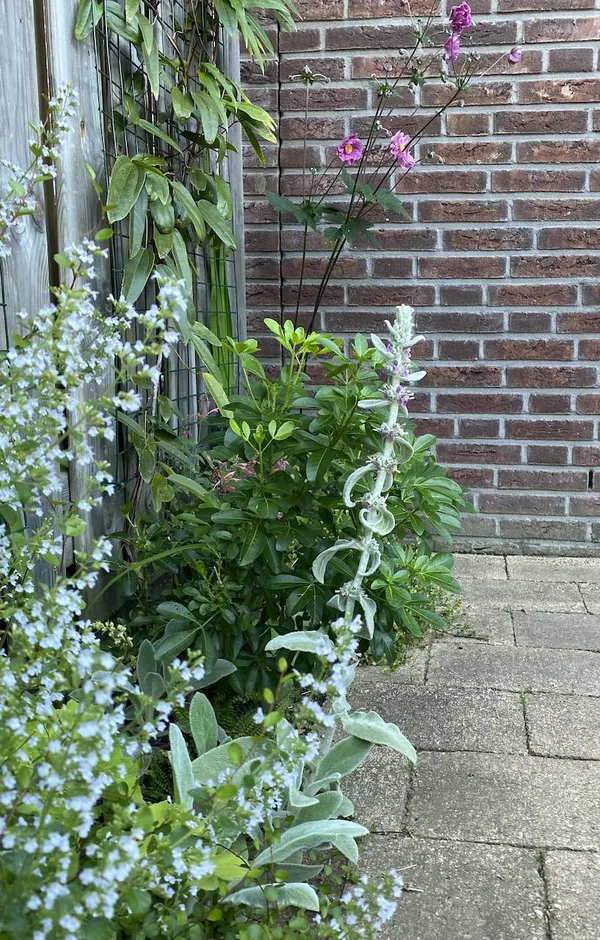
Calamintha, Stachys, Choisya
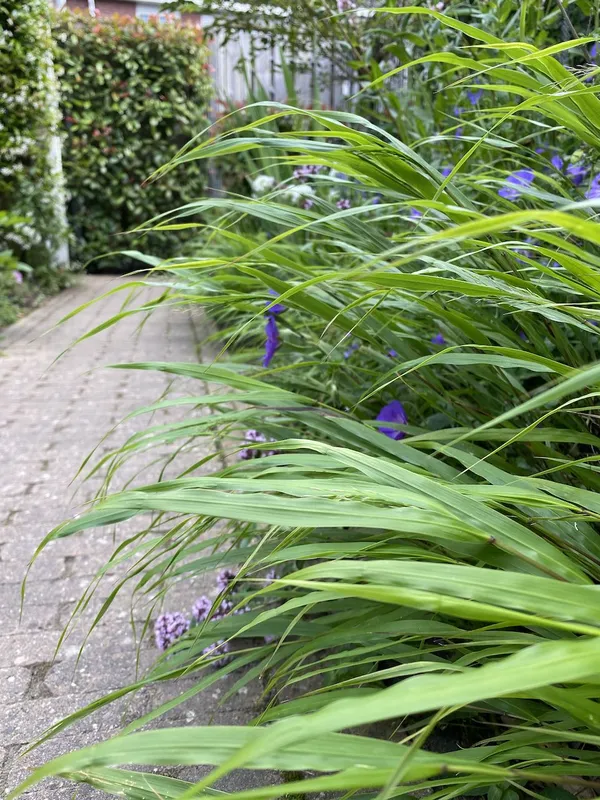
Hakonechloa
Many plants come in different flower colors. For example, you can use the same plant twice—once with a purple flower and once with a white one. It creates a sense of unity, yet remains intriguing.
Finish it off with flower bulbs (no tulips—they take up too much space). Lark’s-spur (Fritillaria meleagris) or summer snowflake (Leucojum aestivum) look elegant in a border like this. Worried your narrow border might end up looking boring? Make sure one plant is an annual and swap it out for a different one every year.