
How Eco-Friendly Gardening Saves a Lot of Work
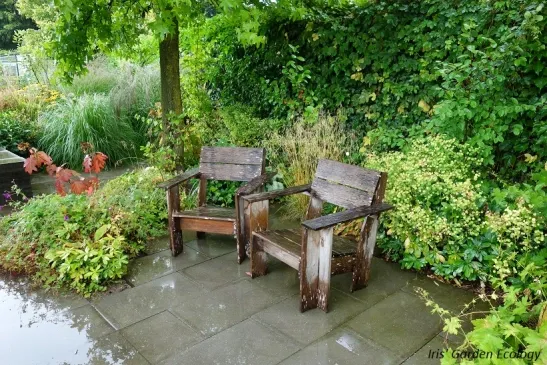
Iris Veltman of Iris’ Garden Ecology is an experienced ecological gardener and regularly writes articles about ecological gardening and sustainable gardens. Of course, she does this on her own gardening blog, but she also contributes regularly to well-known Dutch gardening magazines. She enjoys sharing her knowledge and experience so that we can work together to create greener gardens that are appealing to both people and animals.
Ecological gardening isn't difficult; in fact, it saves a lot of maintenance. How?
Maybe it's easier (but definitely more fun) to illustrate this with a drawing:
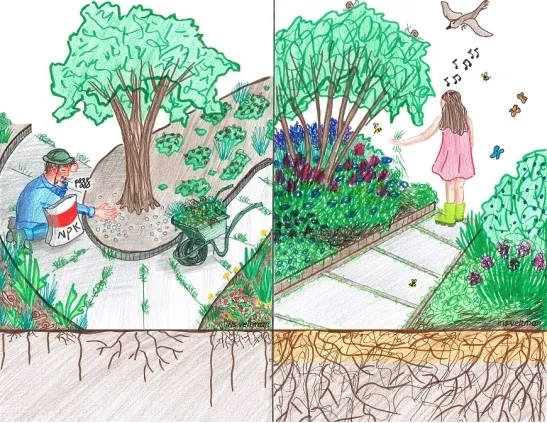
Conventional vs. Organic Gardening
Two days of maintenance per year
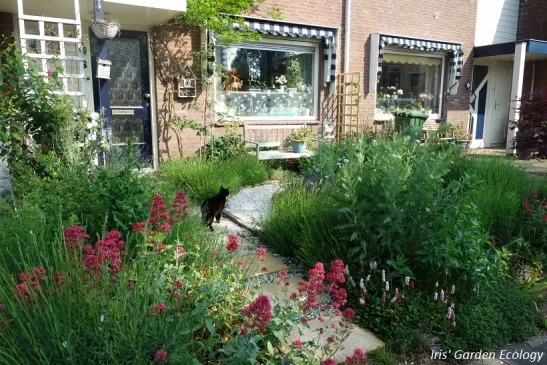
I say this often: I really only do serious yard work two days a year. Pruning—one day for the front and one day for the back. Other than that, I have a path where I have to pull weeds, and that’s about it. So my yard requires very little work. Although my neighbor (with his tiled garden) thinks he has less work to do, because I’m always fiddling around in my garden. Well, he confuses buying new plants out of boredom and constantly looking for spots to put them with actual work…
Maintenance in a Conventional Garden
What does “conventional” gardening—as I’ll call it—involve in terms of maintenance? You fertilize. Usually several times a year, with chemical fertilizer because it works quickly. Your plants get eaten by all kinds of pesky critters, so you reach for insecticides and slug pellets. You keep the soil free of weeds and (usually) plants; you weed or spray whatever pops up unintentionally from March through October. You carefully remove all the greenery you pull out of the flower bed. And then, at the start of winter, you cut everything back; with a little luck, it goes into the compost bin, but usually it ends up in the organic waste bin. You sweep the leaves off the patios and rake everything from the flower beds into a pile, then toss that into the trash can as well. There you go—all tidied up! Until the sun comes out again and the first aphids return to the young leaves en masse attack…
Personally, I find conventional gardening—or ecological gardening done the conventional way (which is also possible; I’ve tried it once)—to be very tiring work. You’re constantly playing catch-up! And so there’s always something new to do. It’s also a lot of work—keeping a piece of nature free from nature :-p
Conventional vs. Organic Gardening
By making the most of natural processes, gardening becomes a lot less tiring and much less work. I’d like to explain this with another drawing. All the red arrows show our work. All the orange ones show the natural processes. So what’s the big difference here?
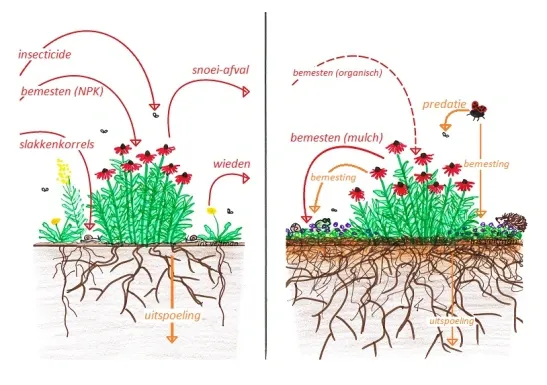
On the left, conventional; on the right, ecological—“in harmony with nature”—in my garden
Fertilization
First: fertilization. Artificial fertilizer dissolves quickly, making it readily available to plants. Because those plants don’t have to work very hard for their food, they develop less root mass. But because that artificial fertilizer dissolves so quickly, it ends up in the water in the soil. A rainstorm quickly washes it away. In any case, some of it gets washed away because the plant roots can’t absorb it all that quickly—especially if those roots have been “pampered.”
Artificial fertilizer also limits the growth of beneficial soil organisms, because it is toxic to them and because there is simply little for them to do. You’re taking the work out of their hands (which creates work for you). Meanwhile, soil organisms also help retain nutrients more effectively and return them to the plant. So: while you’re applying a lot of fertilizer, you’re also experiencing a significant loss of nutrients.
Ground Cover
Second: the bare soil. What a chore, constantly weeding or hoeing! Bare soil just naturally wants to be covered with vegetation, so if we don’t do it, plants will do it for us on their own. If we don’t want that, it’s going to take work—over and over again.
An uncovered soil surface also leads to further nutrient loss. This is because another (significant) loss of nutrients occurs when you throw pruning waste and weeded plants into the organic waste bin. After all, those plant parts have absorbed nutrients from the soil, and those nutrients are then lost again. Uncovered soil is also exposed to the weather, which accelerates erosion. And erosion causes nutrients to be lost from the soil.
Bugs
Third: bugs. Plants and bugs. They go hand in hand. Put a plant there, and bugs will show up. Period. If you don’t want that, you’ll have to keep intervening. And that might even be necessary every week. But by constantly intervening, there’s nothing left for predators to eat (think amphibians, ladybugs, parasitic wasps, lacewings, spiders, hedgehogs, birds, and so on). So they won’t stick around either, and you’ll have to keep doing it yourself.
Gardening in Harmony with Nature
So: why does gardening in harmony with nature actually save time? As for animals: it can be a little scary at first, and it takes some getting used to and patience, but by not intervening right away, you give predators the chance to ‘to rise to the occasion“, or in other words, letting them take over and keep them in check. This can result in some damage from chewing or plants infested with aphids, especially at first. But most plants can handle it just fine.
When I first started, all my plants were quickly covered in aphids—and I mean literally covered. It was a bit of a shock at first, but after two weeks of not intervening (though I did keep a close eye on them), they were suddenly gone. Not a single aphid in sight. Finally, I found a tiny cluster somewhere, and what did I see? Several ladybug larvae were already there, ready to munch on them. Since then, no more problems. Occasionally there’s a small outbreak, but that’s quickly taken care of.
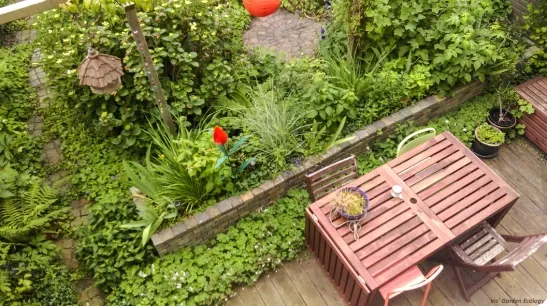
Cover the bottom
So what do I do instead? I do the “chop-and-drop,” which means I put everything I prune from my plants right back on the ground. It also saves me the hassle of hauling and stacking. I use it to cover the soil, where it provides shelter for all kinds of predators, and the remains (mulch) are consumed by beneficial soil organisms, allowing the nutrients to slowly make their way back to the plant. That plant develops a larger root system, which helps prevent nutrients from being washed away.
After a few years, a layer of humus forms, which, together with the mulch layer, improves soil quality and provides a food source for soil organisms and plants. Small animals defecate, die there, and return their nutrients to the soil.
Groundcover plants keep the soil largely weed-free and provide more roots that can retain nutrients in the system. This greatly reduces nutrient leaching. So, in a sense, the system fertilizes itself—for the most part.
Organic fertilizer?
Adding organic fertilizer can improve soil fertility more quickly, but it isn't strictly necessary. Personally, I mainly use my kitchen compost—simply because I have it—as a little extra when it's ready. But doing it more than once a year would be overkill.
So it's really simple…
So it’s actually very simple. Ecological gardening is only a lot of work if you then start deliberately coming up with new ideas out of boredom…
This article and the images used were posted with the permission of Iris Veltman and were previously published on IrisGardenEcology.com