
How (and when) should you prune a beech hedge?
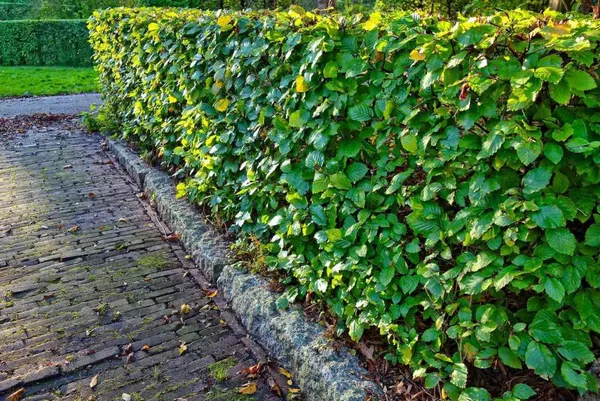
Beech hedges (Fagus sylvatica) are a popular hedge plant. You see them everywhere: around older homes and farms, but also frequently in the city and in new residential neighborhoods. A beech hedge also looks great in a small garden. The fresh green appearance of the beech hedge and its beautiful orange-brown color change in fall and winter make it one of the most attractive hedge plants. To keep your beech hedge in good condition and nicely shaped, you’ll need to prune it. Here’s when it’s best to do this and how to prune your beech hedge. By the way: a beech hedge is not the same as a hornbeam hedge. We’re talking about the true beech hedge here: Fagus sylvatica.
How often should you prune your beech hedge?
To keep your beech hedge in good shape, it’s best to prune it twice a year: in the spring and in late summer.
When should you prune a beech hedge?
The best time to prune a beech hedge is in the spring, after the first growing season. Prune the hedge from late May through mid-June. It’s best to prune before the summer solstice (June 21), so that any gaps in the hedge will close up quickly.
The second pruning for a beech hedge takes place in late August or September. By pruning the hedge back into shape in September, there is still plenty of time for it to recover, and any young shoots will be sufficiently hardened off before the first frost. With this second pruning, your hedge will stay looking good all winter long, since it has much less growth vigor at this time of year.
Do not prune when it is very hot or during a drought. It is better to wait until the drought has passed. Also, never prune when there is frost.
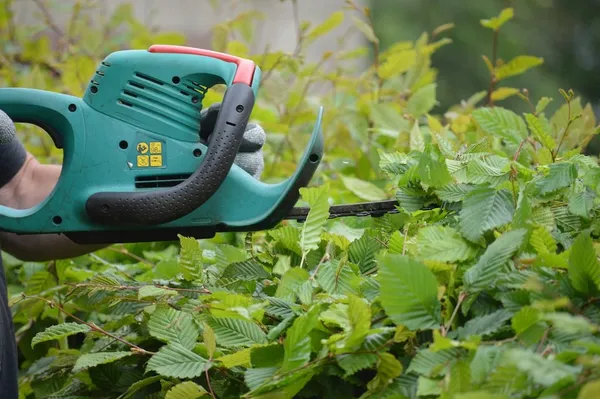
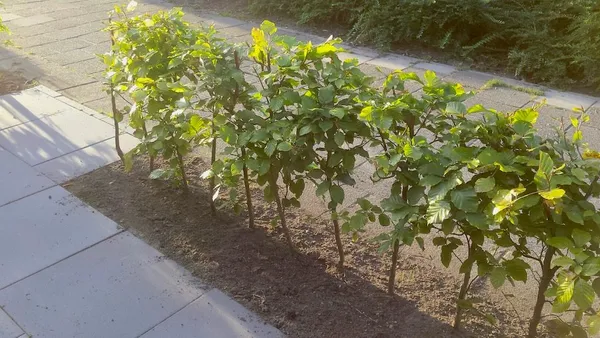
How do you prune a beech hedge (Fagus sylvatica)?
- Make sure you’re well prepared and keep all the necessary tools within reach. You’ll need an (electric) hedge trimmer, pruning shears, a tarp or old sheet, a step ladder or ladder, and possibly a rope to help you create a straight line.
- Check to see if there are any bird nests in the hedge. If there are, you shouldn't prune it so as not to disturb the nest. By the time you prune it a second time, the birds will have already fledged.
- Place the tarp at the base of the hedge so that you can easily clean up all the trimmings later.
- If necessary, stretch a rope or string at the desired height. This will make it easier to prune at the right height and in a straight line.
- Start with the sides of the hedge. Make sure the hedge is slightly tapered (the bottom of the hedge should be wider than the top to allow for sufficient light).
- Work from the bottom up. This makes it easy to keep track of your progress, prevents falling branches from ruining your work, and also makes it easier to trim the hedge so that it tapers toward the top.
- Next, trim the top of the hedge. Make sure you’re working at the right height—above the hedge. That way, you can see exactly what you’re doing and easily achieve a neat, clean finish.
- Hold the hedge trimmer straight and trim the top evenly. Make sure you can reach the entire top of the hedge so you can trim it nice and flat.
- Finish by trimming the top edge: For example, you can choose to create a razor-sharp edge or round off the top nicely. Now your hedge looks spick and span again!
- After pruning in the spring, apply some organic fertilizer and water generously so that the beech hedge can recover properly.
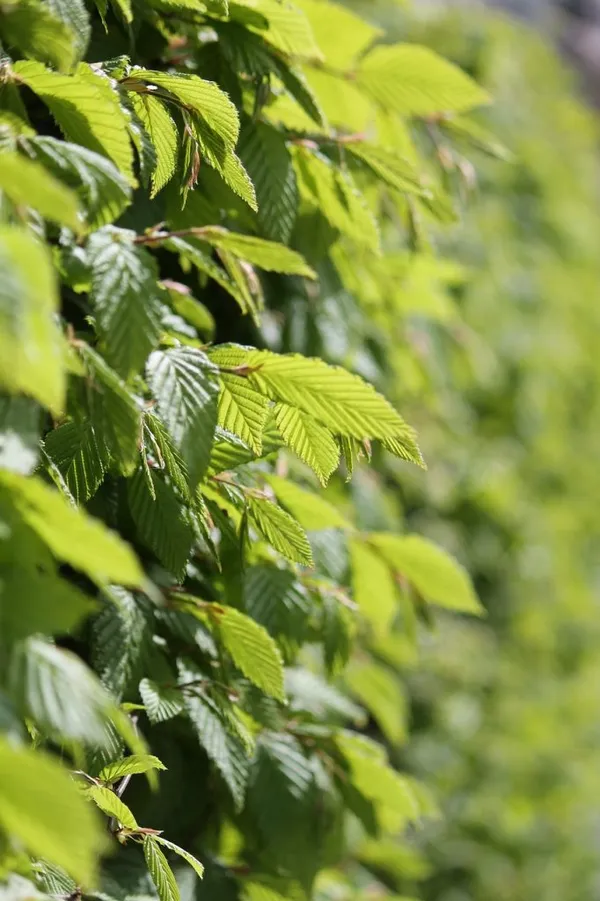
Rejuvenating or Pruning a Beech Hedge
If your beech hedge has grown too large, you can prune it back to make it smaller again. Depending on the age of the hedge, this can be quite a job. The best time to do this is in early spring, around February–March. However, do not prune during a hard freeze, or if one is forecast for the coming week.
Prune the hedge back severely, down to the old wood. It’s best to leave a few buds or shoots so the hedge can grow back more easily and quickly. The more severely you prune it back, the longer it may take for the hedge to recover and grow back properly. Incidentally, a bare beech hedge is susceptible to sunburn. This can happen in a sunny spot, for example, if you’ve removed all the leaves.
After pruning, apply organic fertilizer and water generously and regularly so that the beech hedge can recover as quickly as possible.
If necessary, you can rejuvenate the hedge in stages by pruning it in sections. This involves tackling different sections of the hedge over the course of several years. This prevents you from having to look at a completely bare hedge for an extended period of time.
Trimming, shaving, or pruning?
The terms “trimming,” “shearing,” and “pruning” are often used interchangeably. Trimming refers to shaping a plant or hedge with pruning shears; shearing involves smoothing and shaping hedges; and pruning is the targeted and selective removal of branches and shoots. Nevertheless, the term “pruning” is generally used to refer to all of these gardening tasks.