
Hedges for More Privacy in Your Garden
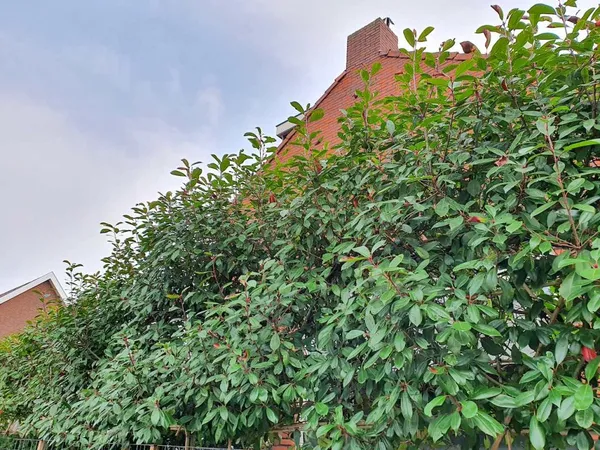
Do you want as much greenery as possible in your garden, even though space is limited? Then consider espalier trees! An espalier tree takes up minimal space but offers the same benefits as a regular tree: It provides privacy, shelter, shade, and a beautiful view. The crown of an espalier tree is narrow and trained along a trellis. You can choose evergreen espalier trees, trees with beautiful blossoms, or a tree with stunning fall colors… there’s an espalier tree for everyone!
The (many) benefits of espalier trees
Espalier trees in the garden are a sight to behold. They are a wonderful addition to any garden and a espalier tree has many benefits. Here’s a list of the benefits for you:
- Trellis trees take up very little space, making them ideal for a small garden! This is a great way to add even more greenery to your garden!
- An espalier tree adds structure and shape to the garden, as well as height.
- An espalier tree is ideal for hiding an unattractive view or an unsightly object.
- An espalier tree also provides shade and shelter from the wind.
- (Lei)Trees provide a source of food and offer shelter for birds, insects, and other animals.
- A well-chosen espalier tree adds ornamental value throughout the year.
- Most espalier trees are easy to prune, sturdy, and hardy.
- Espalier trees can be used as vertical sunshades.
- Deciduous espalier trees block virtually no sunlight from the garden and the house in winter.
- A densely planted trellis can even help reduce ambient noise.
- Topiary trees can be pruned into any shape you like, making them perfect for your garden.
- Older espalier trees, in particular, can increase the value of your home. That’s handy if you’re planning to sell…
- And finally: Hedge trees provide privacy and block the view!
Hedge Trees for Privacy
In a small garden, it’s often difficult to ensure sufficient privacy in an attractive way. Ideally, you’d like to be able to sit comfortably in (part of) your garden without feeling like your neighbors are watching you. Espalier Trees are perfect for preventing people from looking into your yard and ensuring more privacy in the yard.
If you want maximum privacy, you can plant espalier trees to create a sort of "hedge on stilts." Combined with a hedge or fence, this will make your garden virtually completely enclosed—especially if you choose evergreen espalier trees.
Of course, you could also opt for a more subtle solution. For example, by choosing a deciduous espalier tree. That way, you’ll have plenty of privacy during the gardening season and prevent your garden and home from being deprived of light in the winter.
A third option is to combine low-growing plants or see-through plants (or a low fence) with espalier trees. This prevents people walking by (or your neighbors across the street) from looking into your yard, but you can still see through the espalier trees. This way, you’ll feel less confined in your own yard. In the same way, you can also plant just a few espalier trees, so you don’t completely enclose the garden, but instead create privacy, for example, on your patio or around the seating area.
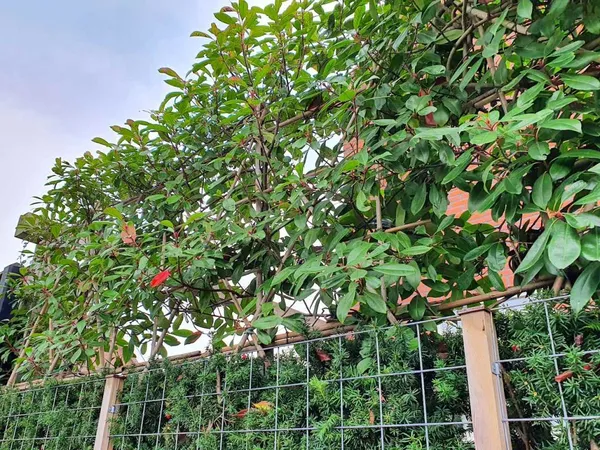
Photinia
Types of espalier trees
Sometimes you’d almost think there’s only one type of espalier tree: the espalier linden. For many people, the espalier linden is synonymous with the word “espalier tree” (just as the “roof plane tree” is for “roof trees”), even though it should, of course, refer only to that specific species: the linden tree (Tilia). Of course, there are many more espalier trees! Other well-known espalier trees include the espalier plane tree, espalier beech, espalier cherry, espalier apple, and espalier pear.
Deciduous espalier trees
The most well-known espalier trees are deciduous trees. They’ve been planted for many years and are still incredibly popular. They add character to your home and garden! One advantage of deciduous espalier trees is that they provide privacy, shade, and shelter during the gardening season, but block as little light as possible from the garden and the house in winter.
- European hornbeam as an espalier tree (Carpinus betulus)
- Tremula (Tilia)
- Spanish plane tree (Platanus hispanica)
Evergreen espalier trees
Do you want greenery all year round? Then choose evergreen trees. These trees maintain the same appearance year-round. However, they may lose some leaves after winter. Evergreen espalier trees are becoming increasingly popular in our country.
- Photinia as an espalier tree (Photinia fraseri)
- Evergreen Magnolia as an espalier tree (Magnolia grandiflora)
- European beech (Fagus sylvatica; evergreen, but turns orange-brown)
- Leihulst (Ilex ‘Nellie R. Stevens’)
- Cherry Laurel (Prunus laurocerasus)
- Olive Willow (Elaeagnus ebbingei)
- Portuguese laurel (Prunus lusitanica)
- Red beech (Fagus sylvatica ‘Atropunicea’; evergreen, but turns orange-brown)
- Holm Oak (Quercus ilex)
Espalier trees with beautiful blossoms
In the spring, enjoy beautiful blossoms in pink or white—or, as with Cornus mas, yellow. In the fall, these trees often bear fruit or take on beautiful fall colors.
- Beaver Tree as an Espalier Tree (Magnolia)
- Yellow dogwood as an espalier tree (Cornus mas)
- Japanese ornamental cherry as an espalier tree (Prunus serrulata)
- Red cherry plum (Prunus cerasifera)
- Red hawthorn (Crataegus laevigata)
- Ornamental Apple (Malus floribunda)
- Ornamental Pear (Pyrus ‘Chanticleer’)
- Winter Cherry (Prunus ‘Autumnalis’)
Trees grown on a trellis with beautiful fall colors or decorative fruits
When many plants begin to die off, or when they lose their leaves without fanfare, these trees treat you to the most spectacular fall colors:
- Sweetgum as an Espalier Tree (Liquidambar)
- Maple (Acer)
- Swamp Oak (Quercus palustris)
- Persian ironwood (Parrotia persica)
- Ornamental Apple (Malus floribunda)
- Ornamental Cherry (Prunus serrulata)
Leifruit
Although espalier fruit trees are usually planted against a wall to increase the yield and allow the fruit to ripen properly, you can, of course, also use a fruit tree as a privacy screen. The yield might be slightly lower, but you’ll enjoy beautiful blossoms and fresh fruit from your own garden! Think of an espalier apple, cherry, pear, or plum tree. You can even train a fig tree as an espalier!
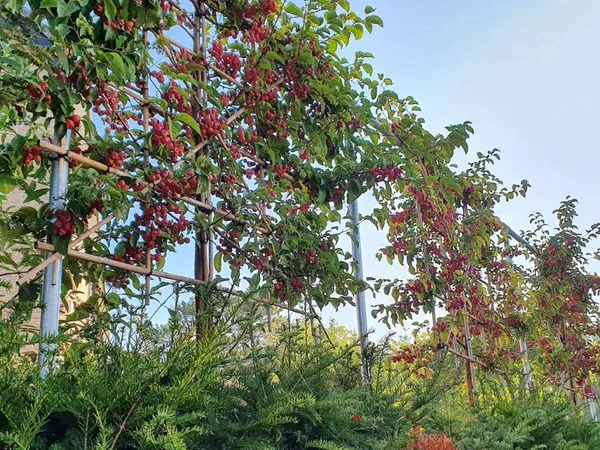
Ornamental Apple (Malus ‘Red Sentinel’)
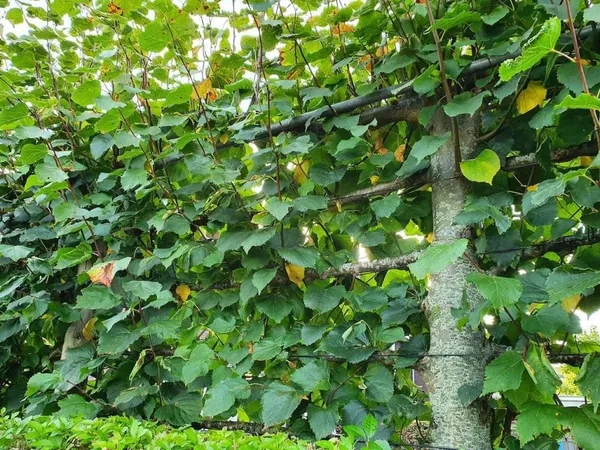
Tremella (Tilia)
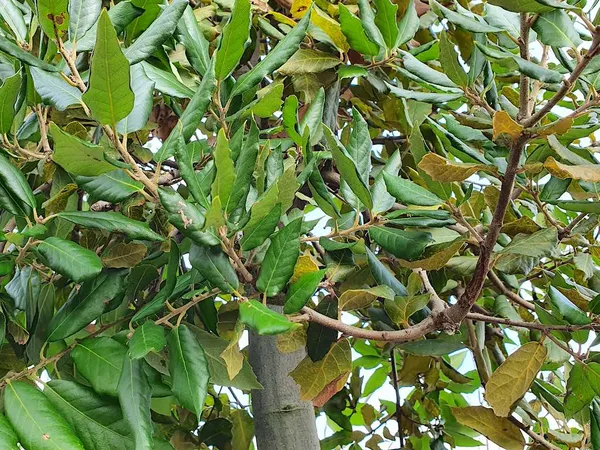
Holm Oak (Quercus ilex)
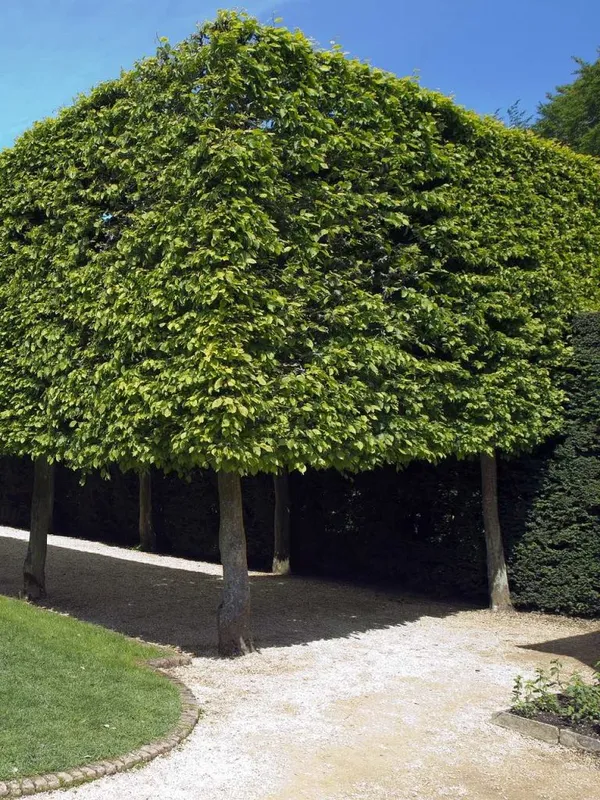
Block-shaped espalier trees
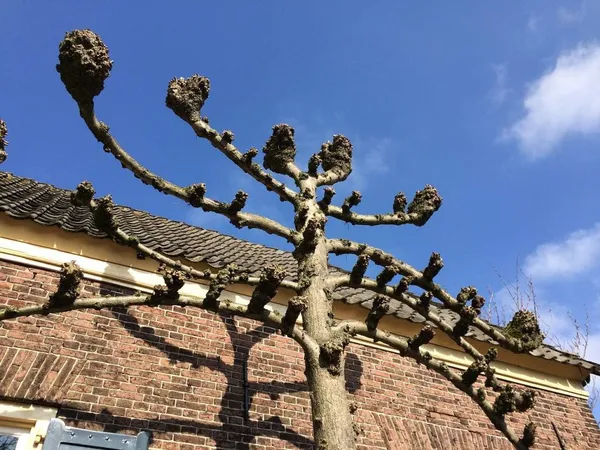
Deciduous espalier tree in winter
What should you keep in mind when it comes to espalier trees in your garden?
When it comes to espalier trees, just as with “regular” trees and plants, you need to choose the right variety. Learn more about the tree and take a close look at the conditions it requires. Will the tree get a lot of sun or very little in your garden, and is the soil light or heavy—does it dry out quickly, or does it stay wet for a long time? Here are our tips for espalier trees in your (small) garden:
- Choose a tree you like! Espalier trees define the view from your home and garden. So it’s important to choose a tree that brings you joy. In a small garden, it’s a good idea to choose a tree that looks beautiful throughout several seasons (has ornamental value). That way, you’ll get the most out of your small garden!
- Choose a spot where the trees can grow well, get plenty of light, and have enough space. Space for the trees to spread out is especially important. However, there must also be enough space for the root ball, since it needs to be able to grow along with the tree over the years.
- If you're planting multiple trees, make sure the main branches and side branches are at the same height. This can be quite a challenge if you want to plant different species!
- Check to see if your new espalier trees are branching out well in all directions, covering all the rungs of the trellis, and make sure the branches aren’t tied too tightly, damaged, or even snapped. It can take several years for these kinds of problems to reoccur.
- Before you plant the topiary trees in their permanent spots, check to see if the current arrangement achieves the desired effect. For example, do they cover up that unsightly wall, or do they prevent the neighbors from looking into your yard, as you intended?
- Make sure you have a sturdy trellis, or better yet, install a sturdy support structure for the trees to grow into. For example, you could use a wooden frame or a combination of posts and a wire structure.
- Water your new espalier trees generously and regularly during their first growing season, and continue to do so even during dry spells. Starting in the second year, you can gradually reduce this. However, always continue to water them more frequently during prolonged dry spells. Once the trees have taken root, you can also give them some extra fertilizer at the start of the growing season.
- Prune your espalier trees regularly. Remove all branches and shoots that grow outside the trellis or the espalier shape. For espalier trees that are already established, this is usually best done during the summer. If you need to form additional branches, winter pruning may be necessary.