
The 7 Most Beautiful Border Combinations for a Small Garden, According to ChatGPT (and Why They Do or Don't Work)
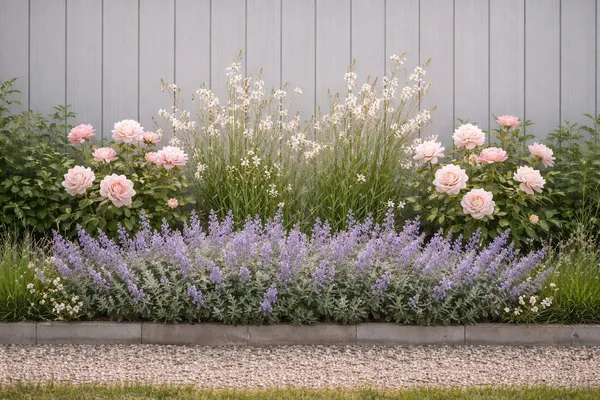
We asked ChatGPT about the best and most beautiful plant combinations for a small garden. We based our question on a border measuring 200 x 50 cm—or one square meter. Of course, ChatGPT responded enthusiastically right away and complimented us on this great and interesting question… 😀
Are you curious about the results, too? You can read about them here:
The Best Plant Combinations According to ChatGPT
ChatGPT: “For a small border in a small garden, it’s all about calm, repetition, and clever combinations. You want it to look full and stylish without getting cluttered. Below, I’ll share a few beautiful, tried-and-true combinations (in different styles), plus why they work 🌿”
1. The Ultimate Favorite (Light & Stylish)
- Lavandula angustifolia
- Stipa tenuissima
- Verbena bonariensis
👉 Timeless, serene, and super popular
👉 Low → medium → high = perfect build-up
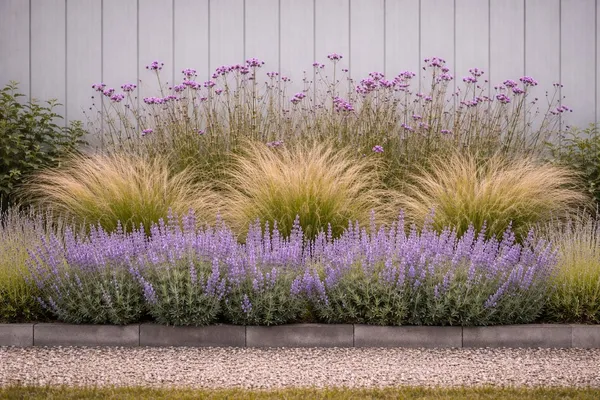
This beautiful combination of lavender, feather grass, and verbena can work well. Keep in mind, though, that verbena will quickly tower over your Stipa (40–60 cm) and lavender. If you’d prefer to avoid this, choose Verbena ‘Lollipop’ (which stays much shorter, at 80–100 cm). The type of lavender you choose also makes a big difference: The popular ‘Hidcote,’ for example, stays low and retains its shape well, but angustifolia grows much taller and wider.
This combination works only in well-drained, nutrient-poor soil, in full sun. Verbena often dies back in the winter, but since it self-seeds profusely, you won't be without it for long.
Our verdict:
A beautiful combination that adds interest even in winter. We would just add one more plant, such as Echinacea, Sedum, or Salvia.
2. Color + texture (most popular combination)
- Echinacea purpurea
- Salvia nemorosa
- Pennisetum alopecuroides
👉 Lots of blooms + still in balance
👉 Long season + nice overlap
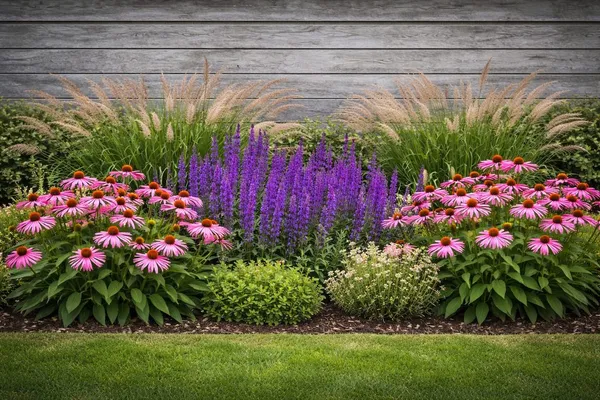
A beautiful combination of popular perennials: red coneflower, sage, and feather grass. Please note: Echinacea blooms from around July through September, but the Salvia will have already finished blooming by then. By pruning it back immediately after flowering, you’ll encourage a second bloom, so you can still enjoy the combination. The Pennisetum ties the border together and adds structure—though only starting in late spring or early summer. In winter, the ornamental grass still adds visual interest, as does the spent coneflower (fall through early winter). In the spring, you prune all these plants back completely, which means there won’t be much to see for a while. You could use flower bulbs to enjoy this border in the spring as well.
Full sun or partial shade is preferred, along with well-drained soil.
Note: Echinacea actually tends to grow a little taller than Salvia, contrary to what the AI image suggests.
Our verdict:
It's a nice start, but we'd really like to see a bit more variety here. Especially to extend the blooming period or enhance the ornamental value of the border.
3. Luxurious Minimalist (Designer Look)
- Buxus sempervirens (or Ilex crenata)
- Allium
- Stipa tenuissima
👉 Sleek, modern, “architectural style”
👉 Strong in the spring + stability for the rest of the year
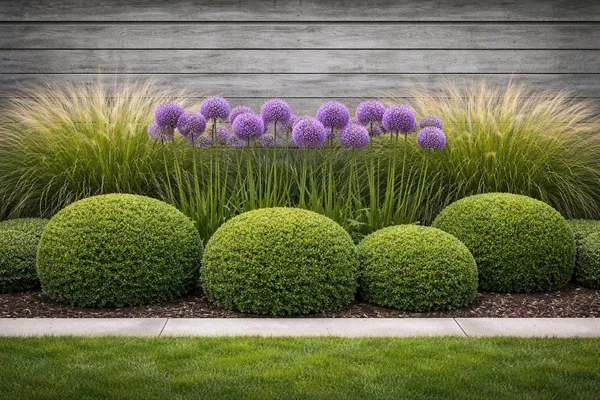
This border remains the same for most of the year: you’ll see evergreen boxwood (or Ilex crenata) interspersed with soft feather grass. In the spring, you can enjoy the beautiful purple (or pink or white) spherical flowers of the ornamental onions. Although their blooming period isn’t very long, ornamental onions retain their shape for a long time even after flowering. Choosing Stipa is important because this ornamental grass is also visible in the spring. The boxwood can be spread throughout this border in a spherical shape or planted as a small hedge.
A sunny location is preferred, or possibly partial shade. Note that Ilex crenata requires acidic soil.
Our verdict:
In our opinion, it's a bit boring, but it could work in, say, a sleek, modern, or minimalist garden.
4. Soft and Romantic (Light Colors)
- Gaura lindheimeri
- Nepeta faassenii
- Rosa
👉 Light, playful, and very elegant
👉 Very long flowering period, soft and airy
A border combination featuring a rose, catnip, and gaura: we definitely love that! Nepeta starts blooming early, and roses often begin blooming in late spring as well. In addition, many roses have red leaves, which adds to their ornamental value. Gaura gets going a bit later in the season but has a very long blooming period. And you can easily extend Nepeta’s blooming period by pruning it after it blooms. It’s worth noting that the specific type of rose isn’t specified. A long-blooming rose is preferred here. If space is limited, a climbing rose is a good option. A rose with pink, white, or purple flowers would be a nice fit. Also, keep in mind that some Nepeta varieties can grow quite tall.
Full sun and reasonably well-drained soil are preferred. The rose prefers nutrient-rich soil.
Our verdict:
A great combination: We can already picture all the bees and butterflies! However, the border does get pretty bare in late winter.
5. Best shade combination (always a good choice)
- Hosta
- Heuchera
- Dryopteris
👉 Grows where little else does
👉 Mainly foliage = stays beautiful all season long
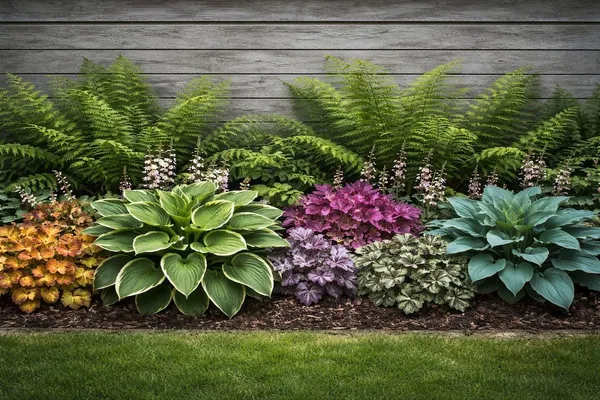
A classic shade border featuring hostas, ferns, and purple bellflowers in the foreground. In the spring, you can enjoy watching both the hostas and ferns emerge, and after a while, the hostas begin to bloom. A hosta with variegated foliage adds extra ornamental value. Depending on the variety chosen, Dryopteris will remain green throughout many winters. The hosta disappears completely from view. Heuchera often remains attractive, and there are many color variations available. Again, this is a combination of only three plants, so you do miss out on some variety when viewed over the entire season.
These plants prefer shade, but not dry shade (so not under a large tree or shrub).
Our verdict:
Shading remains a challenge for many people. Better to go with a safe choice like this than a combination that’s bound to fail.
6. White & Fresh (clean and airy effect)
- Hydrangea paniculata
- Lavandula angustifolia
- Stachys byzantina
👉 Make small gardens look bigger
👉 Strong sense of depth + muted colors
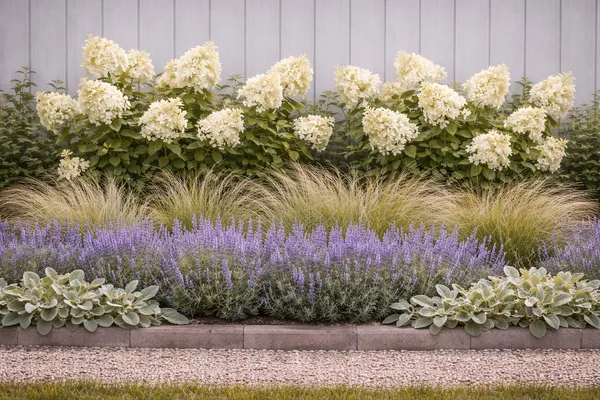
The popular combination of hydrangeas and lavender is actually a very bad match. While lavender prefers dry soil and full sun, hydrangeas thrive in slightly moist soil and partial shade. The solution (which, fortunately, ChatGPT did come up with on its own) is to choose Hydrangea paniculata, also known as the panicle hydrangea. This hydrangea can tolerate the sun better (just like Annabelle). Unfortunately, ChatGPT seems to have momentarily forgotten that this border is a 200x50 cm strip. The hydrangea alone will fill this space. Also, many varieties grow quite tall. Furthermore, Stipa was added when generating the image, which we wouldn’t do in this case because of its tendency to self-seed. This would result in a very cluttered border within one to two years when combined with the hydrangeas. The combination of Stachys and lavender is, however, very beautiful.
Our verdict:
It's beautiful, but not a suitable combination for a small border. This combination is also challenging because of the plants' differing preferences.
7. Prairie Style (Modern & Low-Maintenance)
- Verbena bonariensis
- Perovskia atriplicifolia
- Calamagrostis acutiflora
👉 Lots of movement and a natural look
👉 Tall, airy prairie look
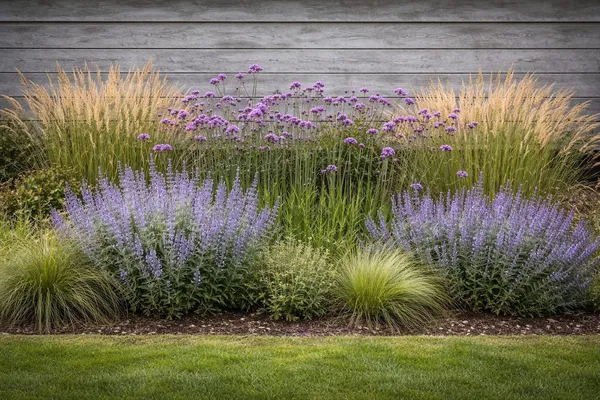
Combining tall verbena with ostrich grass is stunning. This creates a particularly beautiful display starting in late summer. Plus, verbena blooms for a very long time. Adding giant lavender provides extra color and texture. The downside is that there’s not much to see until mid-spring or even late spring. You could add an evergreen shrub to fill this gap, or use flower bulbs. You’re also missing some filler in the foreground.
Full sun and well-drained soil are preferred.
Note: The AI-generated image shows a small Perovskia (such as “Little Blue Spire”), but a tall variety might work even better.
Our opinion:
A very nice combination, but not interesting year-round. Maybe it would work behind a bench or an outdoor table.
Final Conclusion: What Could Be Improved in ChatGPT's Borders?
Let’s be honest: AI has already come a long way. Whereas before you’d get really crazy, unrealistic, or impractical combinations as answers to this question, things are already much better now. However, you still need quite a few follow-up questions to really turn it into a beautiful border. And experience shows that, as you expand the border (and provide more requirements and preferences), ChatGPT still tends to overlook simple details (like soil type, height, and location). This is especially true when you ask it to generate an image of the border.
What goes wrong with ChatGPT border combinations?
Perhaps most importantly: ChatGPT seems to focus only on the summer. In a small garden, it’s naturally even more noticeable that you’re looking out at a bare border at the start of the year. We’re missing structure, form, and early-blooming plants in many borders. When you ask about this, ChatGPT offers the same solution for virtually every border: an evergreen yew ball.
Furthermore, ChatGPT initially “forgets” about shrubs. Only after asking again did it include shrubs in some borders, instead of just perennials and ornamental grasses.
ChatGPT apparently thinks that a nice plant combination consists of a trio by default. Without specifying this, we were consistently given only 3 plants to combine. It was striking that extra plants were often added to the images generated: apparently, ChatGPT thought the image would otherwise be a bit boring… 😉
If you look into it more closely, you’ll probably realize that the cultivar you choose for a plant makes quite a difference. ChatGPT doesn’t specify this (unless you ask for it). However, a plant with a different leaf or flower color creates a completely different border. The height can also vary significantly as a result.
If you create images of your border, you’ll immediately notice that ChatGPT follows the standard border structure: low, medium, high—even if you specifically instruct it not to. Fortunately, this is a bit less noticeable with more plants. In those same images (and also in the plant combinations), it’s also noticeable that the AI doesn’t take the depth of your border into account: having three layers in a border that’s only 50 cm deep isn’t a good idea. If you want to turn a plant combination into an actual planting plan, you’ll quickly run into problems.
Our conclusion:
At this point, AI (tested here exclusively with ChatGPT) isn’t yet a good substitute for a well-designed planting plan. However, it is a good way to visualize new combinations. With the right knowledge, experience, and questions or prompts, you can also get a pretty good idea of whether your combination is a good idea. Although ChatGPT does tend to be wildly enthusiastic about your plans… 😀