
7 Flowering Perennials for Shade
In a small garden, there's often a lot of shade.
Especially if you live in the city!
Many gardeners seem to be afraid of shade. You’d think nothing but moss and ferns could grow there…
Still, there are certainly some beautiful plants that are perfect for the shade and bloom for a long time, too!
If you look into it a little, you'll find that even a lot of plants can tolerate shade quite well. Just think of all those plants that grow naturally in forested areas.
Still need some inspiration?
Which flowering plants can grow in the shade?
Here are our favorite perennials for the shade!
For the most part, these are true shade plants. Some can thrive in both deep shade and partial shade. But there are even plants among them that are actually better suited to a spot in partial shade—or full sun—but in practice also grow (and bloom) just fine in deep shade.
Helleborus orientalis (Eastern hellebore)
Helleborus is one of our favorite winter-blooming plants. They often bloom as early as January and continue through April (if it’s not too warm). They are beautiful plants. A distinctive feature is that the flowers hang downward. If you take a close look at the flowers (lift them up gently, or get down on your knees), they almost seem to have an exotic look. To fully enjoy the downward-facing flowers, it’s worth planting them in a taller pot or a raised border. The foliage of these plants is also attractive. That’s why we use them as groundcover for our palm border. However, the foliage can sometimes look unsightly at the end of winter (just before they start to bloom). You can simply prune this away, and fresh new growth will quickly emerge. An added bonus is that the blooms will stand out even more.
Helleborus orientalis can thrive in both sunny and shady locations. However, they often look much better in the shade. As a result, the foliage is less likely to become unsightly.
There are many different species and cultivars. Our favorites are definitely the orientalis cultivars—for example, Red Hybrids and Spotted Hybrids. Because these cultivars are usually grown from seed, the color may differ from what you thought you had planted. Even if you have several of the same species and variety growing side by side, they’re all still just a little bit different. But that just makes them all the more special to us!
- Height: 30–40 cm
- Flowering period: January–April
- Flower color: pink, red, purple, green, yellow, white
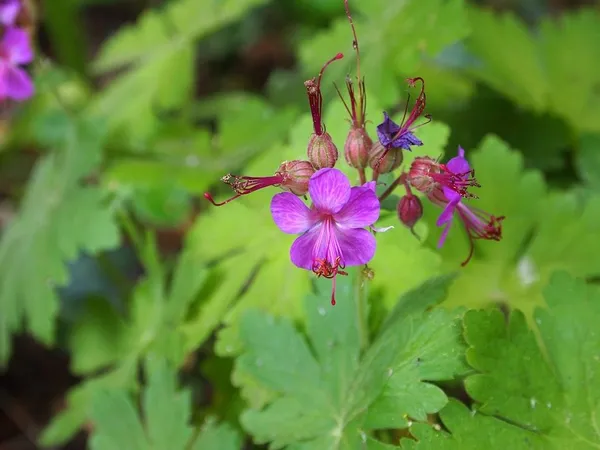
Geranium (crane's-bill or garden geranium)
Geraniums are beautiful garden plants. They have attractive foliage, a profusion of flowers, make excellent ground covers, and often bloom for a long time. There are countless varieties of geraniums, many of which are well-suited for shady locations. Most geraniums have purple, blue, or pink flowers. The blue (or rather purple) flowering and long-blooming cultivars are especially popular. Examples include Geranium Rozanne (also known as Joly Bee), Brookside, and Johnson’s Blue. Well-known pink varieties include Ann Folkard, Anne Thomson, and Sirak.
Some types of geraniums retain their leaves for a very long time (or even all winter in mild winters). These evergreen geraniums are cultivars of Geranium macrorrhizum. The leaves of these varieties also have a wonderful scent! The flowers are a bit smaller, but they bloom in abundance.
As far as we're concerned, a geranium is a must-have in your shade garden. They also work very well at the front of a border, or in a narrow border.
- Height: 20–70 cm
- Flowering season: May–November
- Flower color: blue, purple, lilac, pink, white
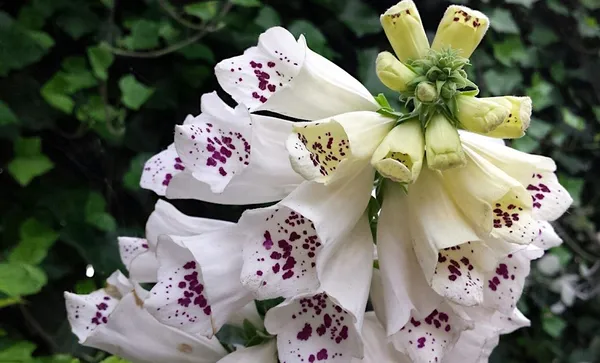
Digitalis purpurea (foxglove)
There are few shade-loving plants that capture the imagination quite like foxglove. Most species easily grow to a height of 1–1.5 meters, and their distinctive tubular flowers are a sight to behold! It’s also worth taking a moment to watch the many bees that are drawn to them as they disappear completely into the deep flowers.
Foxglove is one of those plants you can never have enough of in your garden. They’re especially striking when planted in groups. Even after they’ve finished blooming, you can still enjoy these plants for a long time.
There are several species and cultivars, of which Digitalis purpurea is the most widely available. The colors range from shades of purple, pink, and white. Salmon-colored varieties are also available these days.
Actually, Digitalis isn’t a true perennial, but a biennial. In the first year, foxglove forms leaf rosettes, and then blooms in the second year. By sowing the seeds in late summer, you can ensure that the leaf rosettes form this year, so you can enjoy the beautiful blooms again next year.
- Height: 90–150 cm
- Flowering season: June–August
- Flower color: purple, pink, white
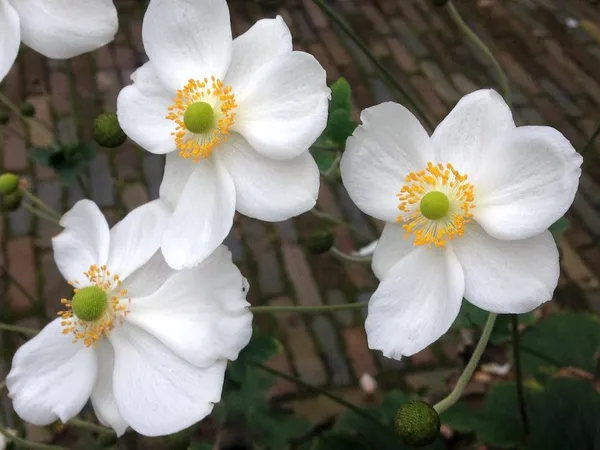
Anemone hupehensis or Anemone hybrida (autumn anemone)
The fall anemone is a plant that you rarely see until well into spring. Then, in a very short time, a carpet of foliage emerges, growing taller each week. From mid-summer through late summer, you’ll see the flower stalks appear. Depending on the species and variety, they can bloom for quite a long time—from around September through November or December. Fall anemones bloom profusely, and their flowers are simple yet beautiful to behold. Bees also love the open flowers!
They bloom mainly in white or pink (with a yellow center). Well-known varieties include Anemone Honorine Jobert and Elegans, Königin Charlotte, and Splendens.
Many fall anemones can spread quite a bit in your garden. That's something to keep in mind.
- Height: 70–120 cm
- Flowering period: August–November
- Flower color: pink, purple, white
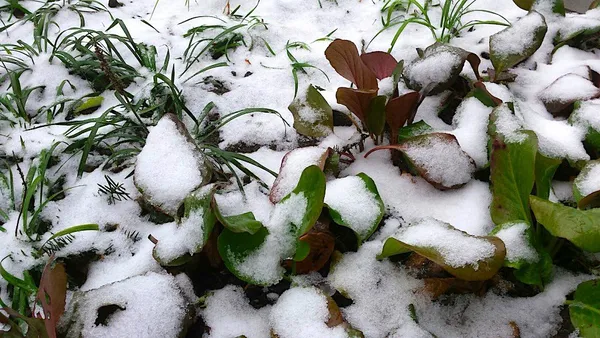
Bergenia cordifolia (shoe-leaved bergenia)
Many people dismiss the cobbler's plant as old-fashioned or even boring… This is really unfair!
Bergenia is evergreen, and its leathery, glossy leaves have a distinctive shape. The leaves actually only die back during very harsh winters. It makes a good groundcover for difficult spots. In addition to its attractive foliage, it also produces beautiful, yet subtle, blooms. Bergenia typically blooms with pink, upright clusters, but there are also white cultivars. There are also cultivars with foliage in different shades.
There's a lot of Bergenia growing here next to our mini-pond. If you look closely, you can often see salamanders hiding under the leaves and among the stems.
Bergenia is suitable for deep shade, but can also be planted in partial shade. In theory, it can even be planted in full sun, but we don't have any experience with that.
- Height: 20–40 cm
- Flowering season: March – May
- Flower color: pink, white
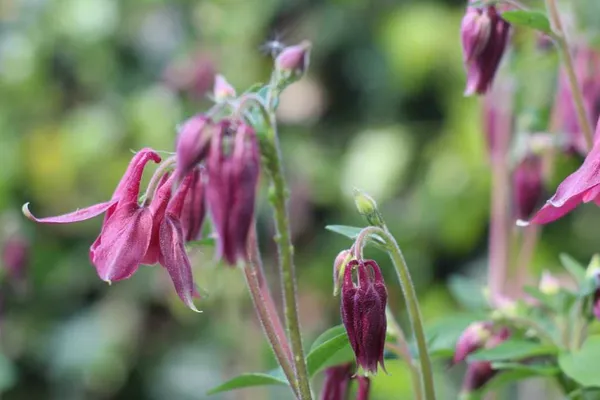
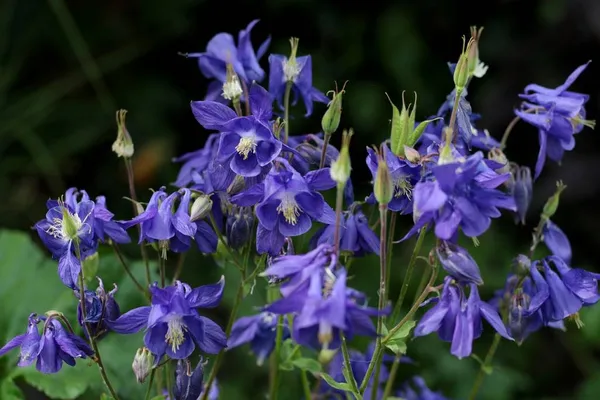
Aquilegia vulgaris (columbine)
Columbine is a unique and graceful plant that is actually much too rarely planted in Dutch gardens. Its beautiful, delicate flowers bloom around May and June. The flowers have a very natural look. Even after they’ve finished blooming, you can still enjoy their beautiful, distinctive leaf shape for a long time.
The Barlow series may well include the most beautiful cultivars. Aquilegia Nora Barlow is the original cultivar (pink), from which the popular Blue Barlow and Black Barlow were also developed.
Actually, columbines prefer partial shade, but they remain very beautiful even in full shade. These plants can self-seed, so keep in mind that they may also sprout elsewhere in your garden. In theory, this is more likely to happen in partial shade or in a sunny spot. Still, we can hardly imagine that you wouldn’t be happy to have more of these beautiful and graceful plants.
- Height: 40–80 cm
- Flowering season: May–June
- Flower color: pink, red, purple, blue, yellow, white
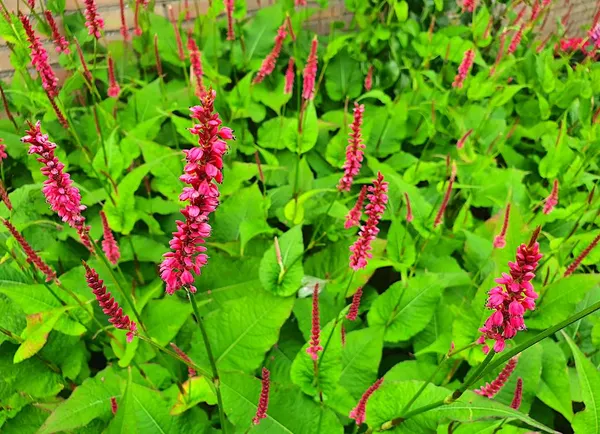
Persicaria (knotweed or viper's root)
Knotweed (not to be confused with the invasive Japanese knotweed) is a hardy, long-blooming garden plant. Persicaria can also be used as a taller groundcover and blooms with countless brush-like flowers. The flower color ranges from red and pink to white. Flowering usually begins in mid-summer and continues until the first frost. Persicaria is not evergreen, but its leaves remain on the plant for a very long time.
Actually, Persicaria isn’t really a shade plant (at least not the amplexicaulis variety), but it’s very versatile. Knotweed grows just as well in the shade—though it might bloom just a little less. Persicaria bistorta, however, is a species that naturally grows in the shade.
Persicaria can spread easily in the garden. Dividing the plant regularly keeps it under control.
- Height: 70–150 cm
- Flowering season: August–November
- Flower color: red, pink, lilac, purple, white
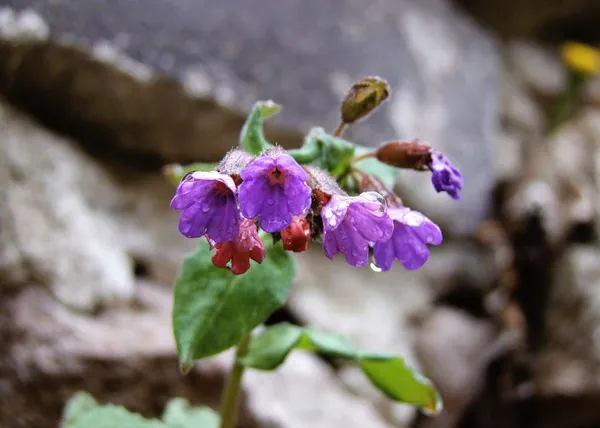
Pulmonaria (lungwort)
Lungwort has a beautiful, natural look and is often used as an easy groundcover. Most varieties have distinctive white-spotted leaves. Lungwort produces small, tubular flowers that change color from blue to pink. This means you can see both blue and pink flowers on a single plant at the same time. Bees, by the way, are constantly flitting back and forth to lungwort. Snails usually leave them alone.
Are you less fond of the white-spotted leaves, or do you want the most beautiful blue-flowering lungwort? Then Blue Ensign is a good option.
- Height: 20–40 cm
- Flowering season: March–May
- Flower color: blue, purple, pink
So: In our opinion, these are the most beautiful and best plants for shady spots…