
10 Tree-Shaped Trees for a Small (Front) Yard
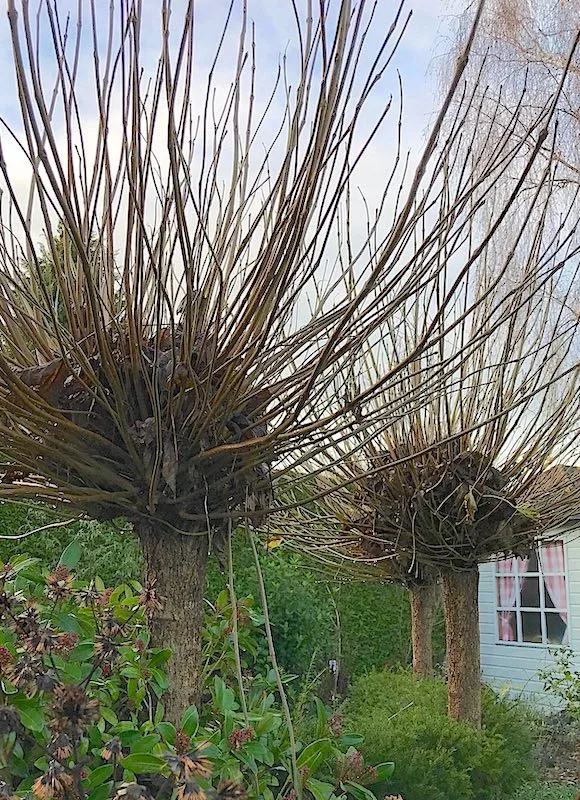
Is your front or back yard not very big, but would you like to have a tree in your yard? Then consider a compact tree. These are trees that are easy to keep small yet still look very elegant in your yard.
Spherical trees are grafted onto a rootstock (usually between 180 and 220 cm tall). This means that the branches don’t start growing until that height. They grow in a spherical shape, and by pruning them annually or every two years, you can easily keep these trees small. Each time, prune back to about 50 cm from the trunk (or, more precisely, the graft). Some varieties can even be pruned all the way back to the graft (pollarding). Because the trees are grafted onto a rootstock and thus have a fixed trunk height, most varieties do not grow very tall.
Here, you often see ball-shaped trees in front yards and along driveways. They’re often planted in pairs or in a neat row. One or more well-maintained ball-shaped trees immediately give the garden a neat and well-kept appearance. They also help block the view from the street and add height to the garden design.
Well-known bulbous trees
Ball-shaped Catalpa (Catalpa bignonioides ‘Nana’)
The ball-shaped catalpa (trumpet tree) is perhaps the most commonly planted—or at least the best-known—ball-shaped tree. This tree, with its exceptionally large leaves, remains extremely popular. The leaves are a fresh green and more or less heart-shaped. Catalpas bud out relatively late. As the tree ages, shallow grooves form on the trunk. It’s a vigorous grower, so annual (or biennial) pruning is definitely necessary.
Bolacacia (Robinia pseudoacacia ‘Umbraculifera’)
The globe acacia is another widely planted tree. Unlike the catalpa, this tree has very fine, round leaves. The leaves are a fresh green, and the trunk is grooved.
Norway Maple (Acer platanoides ‘Globosum’)
This holly develops an oval crown. However, as it matures, this tree can grow quite wide. Its distinctive leaves are large and coarsely toothed. Young leaves are brownish-red in color and later turn dark green. In the fall, the tree’s foliage turns golden yellow.
Globe Plane Tree (Platanus hispanica ‘Alphens Globe’)
When most people think of a sycamore, they think of a roof-shaped sycamore, but the dome-shaped variety is also being planted more and more often. Sycamores grow quite quickly and soon form a dense dome. Sycamores have exceptionally large leaves.
Less Well-Known Bulb Trees
Round Sweetgum (Liquidambar styraciflua ‘Gum Ball’)
Do you want to enjoy spectacular fall colors in your garden, but have limited space? Then the Gum Ball is a good choice. Its distinctive hand-shaped leaves turn striking shades of yellow, orange, and red in the fall. The tree also produces some prickly fruits. Like all globe trees, the sweetgum tree is easy to keep compact.
Round-crowned manna ash (Fraxinus ornus ‘Mecsek’)
The feathery ash has slightly glossy, dark green leaves. The trunk is smooth and gray to gray-black. Around May and June, white flower panicles appear on the tree. Fruits are usually not produced. In the fall, the leaves turn golden yellow to purple. In addition to feather ash, this tree is also known as dwarf ash.
Field Maple (Acer campestre ‘Nanum’)
This globe maple develops a beautiful, dense crown. Although the field maple is usually used as a hedge plant, the globe-shaped variety is definitely worth considering. In the fall, the leaves turn a lovely dark yellow. This tree is also known as the Spanish Aak.
Japanese ginkgo tree as a specimen tree (Ginkgo biloba ‘Mariken’)
The Japanese nut tree has uniquely shaped foliage. Strictly speaking, these aren’t leaves at all, but rather small needles that have fused together to form a leaf. It is, therefore, a deciduous conifer. Ginkgo trees have a gray trunk, and as they age, the trunk develops more and more grooves. Eventually, large knots form on the trunk (on very old specimens). In the fall, the Japanese ginkgo displays spectacular fall colors. The leaves turn a bright yellow (unfortunately, only for a short time)! After the leaves have fallen, the yellow leaves remain on the ground beneath the tree for quite some time.
Round-leaved Swamp Oak (Quercus palustris ‘Green Dwarf’)
This swamp oak has a beautiful, densely branched crown. Its large, lobed leaves are dark green and glossy. The trunk and older branches are gray, while young branches are still olive green. The fall color ranges from red to brownish-red. Swamp oaks are also suitable for wetter locations.
Bolkers (Prunus eminens ‘Umbraculifera’)
The ball-shaped plum, or ball prunus, has a beautiful compact shape and naturally grows in a spherical form. In the spring, the tree undergoes a complete transformation as it becomes entirely covered in white blossoms. In the fall, the leaves turn orange-yellow. This spherical shape requires little to no pruning to remain compact.
Even more conifers
Many trees and shrubs are now also available in a ball-shaped cultivar. Well-known examples include laurel, privet, hornbeam, olive willow, holly, firethorn, and photinia. These trees are sold both as “ball-shaped trees” and as standard trees or shrubs.